
Introducing the latest myCWT product and service enhancements
Building on our digital, omnichannel myCWT platform, our new products and services will simplify travel management for you and your employees – anytime, anywhere, anyhow.
Note: Featured services may not be available in your country at this time. Please reach out to your CWT representative for more details.
Hear from Chief Product Officer, Erica Antony as she shares the key product highlights of 2024, along with the key areas driving innovation.
-
2040: Baseline, Boom or Bust
As we enter an era of rapid transformation and unprecedented challenges, it is essential for travel managers, meeting & event planners, and corporate decision-makers to look ahead and frame our current strategic thinking with a clear vision of the future. Business travel and meetings and events (M&E) are poised for significant change over the next decade and a half, driven by a complex interplay of sustainability goals, technological advancements, evolving work models, and geopolitical dynamics.
In this paper to mark the 10th anniversary of our Global Business Travel Forecast, we explore, for the first time, a long-term vision of the future and potential trajectories through three distinct scenarios, each offering insights into how these forces should affect policy-making, budgeting and priorities. By examining these scenarios, we can better understand the diverse possibilities that lie ahead and the strategic imperatives required to thrive in each potential future.
Based on trajectory data analysis and interviews with industry leaders, behaviorists and climate tech founders, this forward-looking approach enables us to anticipate changes, strengthen our strategies, and make informed decisions that align long-term objectives. It is through this lens of foresight and adaptability that we can build resilience, seize opportunities, and navigate the complexities of the future.
We invite you to reflect on the insights presented, and consider how your organization can prepare for the opportunities and challenges that lie ahead. Together we can ensure that travel and meetings remain catalysts for growth, scalability and sustainable practices.
- Scenario development is both an art and a science
- Megatrends Shaping the Future of Business Travel, Meetings and Events
- Sustainability goals the new crux of corporate policy
- Technology Revolutionizes Travel Management
- Modern work models spark new travel patterns
- Changing demographics open doors to new opportunities
- Three Scenarios: Base case, boom and bust
- Future-proofing strategies

-
CWT GBTA Global business travel forecast 2025
When it comes to pricing, global business travel has finally reached an enduring, higher baseline. Prices will continue to rise in 2025, but only moderately, so expect a period of normalized growth.
However, this pricing environment, one of marginal gains and price regularity, is fragile. Global leisure travel has now realized a lot of its pent-up demand, while corporate travel has been resurgent, with 2024 edging at preCovid levels.
There are many factors at play, whether its volatile oil prices, labor costs and constraints, inflationary pressures, and geopolitical factors. As this elevated baseline edges upwards, albeit marginally, travel budgets will come under increased scrutiny, especially as travel patterns and attitudes change.
It’s why business travel can’t be viewed in a silo, and the true value to an organization must be fully realized. This forecast can help with those calculations.
-

Capitalize on emerging technologies in corporate travel
Technological advancements are accelerating at an unprecedented pace. How will emerging innovations like Generative AI, blockchain, and self-sovereign identity (SSI) transform corporate travel?
BTN and CWT probed global CEOs, travel managers, industry consultants and tech experts on the promises, questions, and expectations these innovations raise and how they are set to reshape traveler experience, cost control and service delivery in corporate travel and events.
Download and discover
- The technologies that will have the greatest impact on corporate travel in the next 2-5 years
- How these emerging technologies are poised to control costs, enhance service and security, and boost efficiency
- The critical challenges, opportunities, risks and roadblocks each innovation raises
- What travel managers, buyers and experts anticipate from these innovations
-
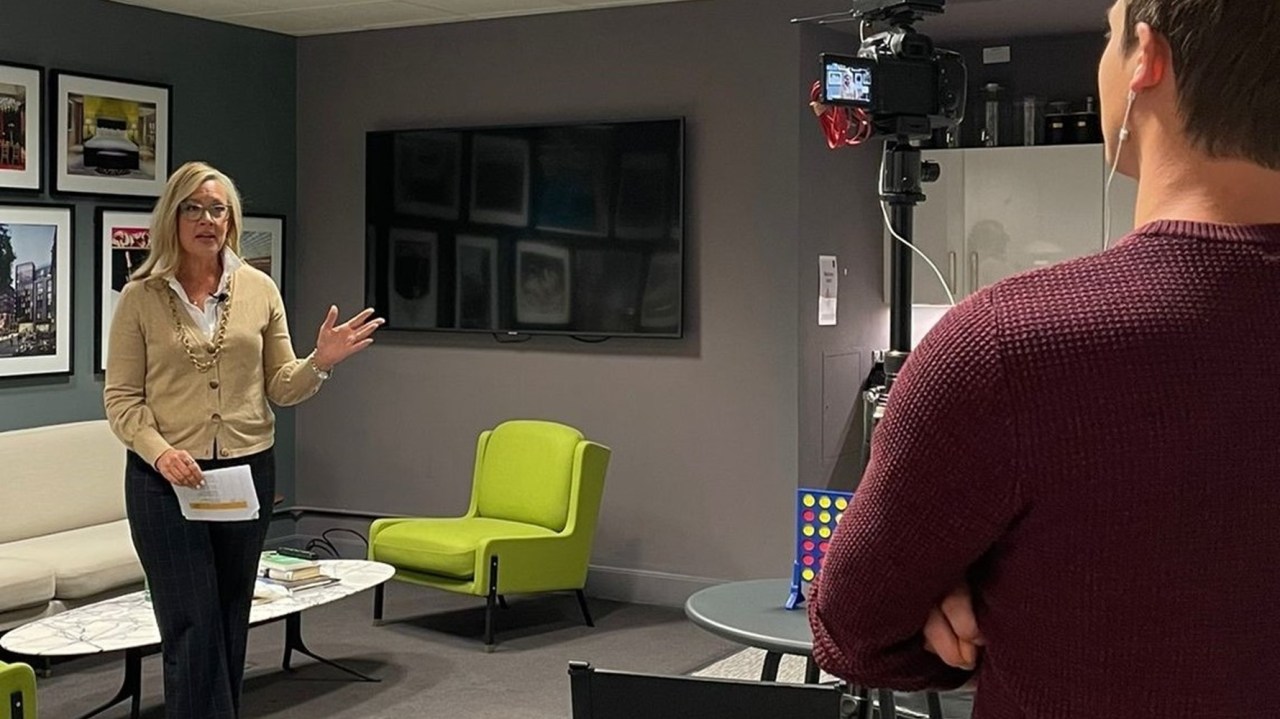
Meetings in a post pandemic world: Status quo or a whole new game?
I’m going to start by stating the obvious: The way businesses operate has changed since the pandemic. Crazy right? Not really – these changes were felt in all industries, all over the world. In our world, this fundamentally changed the core of how we met.
In the space of just over two years, we went from meeting in person, to meeting entirely remotely, to where we are now. Many, including myself, predicted that the hybrid meeting was here to stay for months if not years to come. Amid the tsunami of demand, we are seeing what may be most surprising: the sudden decrease in demand for virtual and hybrid meetings. The human need to connect – live and face to face – is so strong that 99%+ of the meetings we are supporting are in fact fully face to face. Given this reality and the unprecedented pace stressing the ecosystem of meetings & events, we need new strategies and a new approach.
This begs the question: how can you better manage your meetings in this post pandemic world to benefit your business? I sat down with two members of my dream team, Amy Harris, Global Director, Client Strategy and SMM (Strategic Meetings Management) Center of Excellence, and Ami Mayfield, Senior Director, Global Customer Management, to answer exactly this.
- Diligently focus on increased risk mitigation: From contract clauses to duty of care, the risk associated with executing meetings has increased. During the pandemic, suppliers changed their terms and conditions rapidly to protect themselves. For example, we saw cancelation windows of 6 months cut to just 30 days. Ami Mayfield pointed out that our clients are refining their strategy, to protect themselves from the financial and duty of care risk related to the pandemic.
Mitigating risk is still a critical component of a best-in-class strategy. Managing your meetings strategically will enable you to better protect your meetings program, and your business from the economic, duty of care, and financial risks that exist today. - Turbo charge your negotiating power: “Post pandemic, corporations are seeing increased value of strategically managing their meetings.” said Amy Harris. In fact, meetings have moved from a nice to have to a strategic asset. Today our clients ask about avoiding cancellations, cutting costs, and finding mutually beneficial terms and conditions. A way to achieve this is by bringing all your meetings to the negotiating table with suppliers.
Single events give you very little wiggle room in terms of buying power. However, if you can determine your full book of meetings and events needs and bring this to the table, you will have much more negotiating power to create a relationship that is mutually beneficial.
- Include all meeting types in your strategy: Your meeting strategy should be designed to bring value to any type of meeting or event – from the smallest internal meeting to the largest incentive. Ensuring a companywide approach across all meetings optimizes both the opportunity and impact for your company.
“[This approach] brings consistency in brand. It brings consistency and experience in delivery. You gain visibility that gives you valuable data that you can take to suppliers and really talk through those supplier relationships,” said Amy Harris.
Driving an inclusive strategy extends well beyond the meetings department. More than 70% of professionals responsible for travel management now have some responsibility for meetings as well. This means that for many businesses, the return to meetings and the return to travel should be managed side by side rather than separately, to allow for greater alignment and benefits such as cost savings and traveler/attendee experience.
Welcome to Total Meetings Management
Focusing on these strategies will start your company on the path to what we call Total Meetings Management. This is an approach that means you align and manage all your meetings under one strategy to optimize cost reductions, buying power, risk mitigation, and to drive efficiencies. Through this approach, your stakeholders move from managed/engaged to true advocates supporting greater adoption and next level conversions truly optimizing your company’s investment in meetings & events.
- Diligently focus on increased risk mitigation: From contract clauses to duty of care, the risk associated with executing meetings has increased. During the pandemic, suppliers changed their terms and conditions rapidly to protect themselves. For example, we saw cancelation windows of 6 months cut to just 30 days. Ami Mayfield pointed out that our clients are refining their strategy, to protect themselves from the financial and duty of care risk related to the pandemic.
-
Transylvania beyond the legend of Dracula: The region has much more to offer than its famous vampire
Let’s start from scratch, as if we have never heard of vampires, stakes, or the infamous Count. This is the way to introduce Transylvania for what it is, a Romanian region of impressive forests and misty roads that lead to picturesque cities and medieval castles and fortresses.
With the Carpathian Mountains always in the background, ‘the land beyond the forest’ is home to 5,000 brown bears. Its landscape offers spectacular views including the Transfăgărășan highway, named the world’s greatest driving road.
Why go to Transylvania?
Romania has achieved impressive growth and prosperity over the past two decades. Its infrastructures and communications have improved considerably since the country joined the European Union in 2007. As a result, Transylvania is emerging as a very attractive destination for groups and events.
Reaching its main attractions and cities is easy. Brasov, Sibiu and Sighisoara form a triangle of quaint cities, each with their own beauty and reachable within a two hour drive. Sibiu has an international airport with flights to many European cities, whereas Bucharest Otopeni International Airport is 3 hours away from Brasov. Accommodation has improved in conjunction with the country’s overall development and that means there is something for most budgets, from international hotel chains to boutique guest houses and upmarket lodgings.
However, despite these modern advances, traveling around Transylvania somehow feels like one has gone back in time, which adds to the region’s charms. There are still horse-drawn carts and donkeys on the side roads and you still spot villagers dry hay in the sunshine.
Affordable destination
Transylvania is a cheap destination for groups and conventions. If we compare Sibiu with two popular European destinations like Barcelona or Munich, restaurant prices in Barcelona are 98.49% higher whereas consumer prices in Sibiu are half the price than in Munich, according to Numbeo (as per October 2022). The price per attendee in Transylvania is one of the cheapest in the European Union, including other Eastern European cities like Prague or Krakow.
Hearty food and local Schnapps
Transylvanian cuisine reflects its complicated past and the varied history of its population. It is best described as a fusion of Romanian agrarian culture with influences from Hungarian, German, Turkish and Slavic dishes.
The most traditional food in Transylvania is Sarmale, pickled cabbage rolls stuffed with meat and rice. In recent years, a vegan version has been added to the menu, usually stuffed with mushrooms. What hasn’t changed is the popularity of the local schnapps, Palincă isa high-octane liquor made mainly from plums that can easily knock down the bravest drinker.
The world’s greatest driving road
For those that get their kicks from high adrenaline activities, driving the Transfăgărășam highway is a must. Featured in the British motoring TV show, Top Gear, the highway begins 50 kilometers east of Sibiu with tree-lined hairpins leading to a barren valley.
Keen drivers from around the world travel to Transylvania to experience driving the sinuous ascends and descends of the Făgărăș mountains in a string of hairpin turns, corners and amazing views. Heavy snow means the road is only open from June to October, so be sure to visit during the summer months.

The place to be for bear spotting
The Carpathian Mountains are home to around 5,000 brown bears, Europe’s largest population. Some even roam around mountain roads to the delight of the lucky visitors that spot one. There are a number of hides to observe bears in the wild with a ranger, many of which are available to book for those groups not willing to leave the experience to chance.

The perfect castle for a vampire
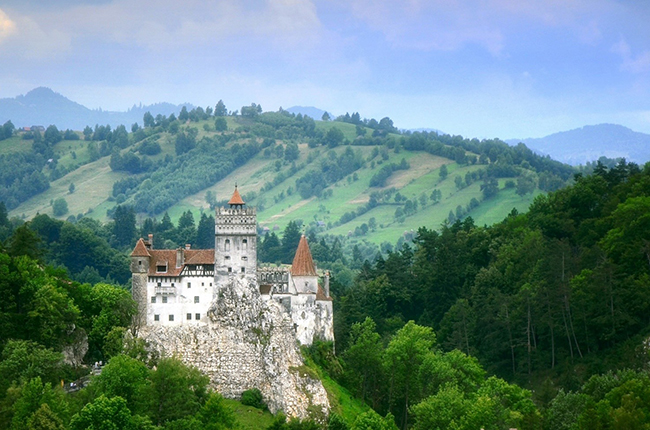
If you were to try to find a castle that is reminiscent of Dracula’s home, it would be Bran castle. Perched on a hilltop, the medieval fortress has narrow corridors, steep stairs and dark corners, the perfect place for a Count with a taste for impaling their victims. Bran castle is worth a visit even if there is no evidence that Bram Stoker knew anything about it when he wrote his novel in 1897.
Where to host in Transylvania?
Sighisoara: much more than Dracula’s birthplace
As in all myths, the truth around Transylvania’s infamous count, navigates between historic events and the prolific imagination of writers like Bram Stoker. One thing for certain is that Vlad Drăculea Aka Count Dracula, was born in Sighisoara. But that’s not the reason why the city entered the list of UNESCO World Heritage. The real reasons lie in the beauty of this well-preserved medieval city that sits on top of a hill, overlooking a green valley surrounded by city-walls. Sighisoara cobbled streets, relaxing atmosphere and fancy restaurants made it an ideal destination for small to mid-size meetings. As with everything in Romania, it is not overly exploited by mass tourism, so visitors won’t get the crowds seen in Bruges or Prague.
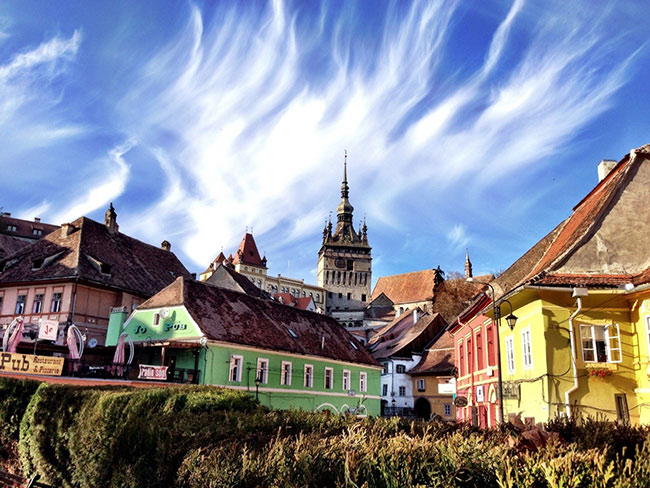
Sibiu: the city staring at you
Sibiu is a vibrant city famous for its eye-shaped ceiling windows. Its international airport and proximity to Transylvania’s main attractions makes it a good starting point to explore the region further.
Capital of the Saxon settlement in Transylvania, Sibiu has a distinctly Germanic feeling. The city has history and architecture, but above all, what conquers the visitor is its relaxed and happy vibes. Its pedestrianised streets are full of restaurants and entertainment, and its hotels offer a wide range of meeting and conference rooms.

Brasov: history and nature combined
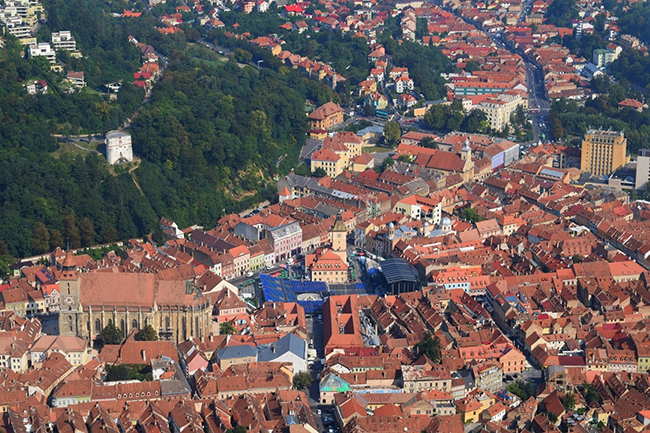
Brasov is one of the most beautiful and most visited places in Transylvania. It’s a very well-preserved medieval city with cobbled streets, incredible palazzos, and churches. Its pedestrianized city center offers a wide selection of restaurants and cute little shops.
One of Brasov main attractions is Mount Tampa. The mountain overlooks the city and is home to many species from brown bears and lynxes to butterflies and a wide variety of birds. Walking to the top takes about an hour and visitors can also ascend its 940 metres by cable car. Perfect for those attendees keen to the outdoors.
-
Hello, Nĭ Hăo: Why this multinational tech giant has chosen a bilingual service hub model for its travel program beyond China
The last two decades have witnessed the meteoric growth of Chinese companies, with many venturing into international markets. As recently as 2005, there were only 16 Chinese firms in the Fortune Global 500 – almost all of which were state-owned enterprises. This year, there are 145 companies from Greater China on the list, accounting for 31% of the total revenue of the world’s 500 largest corporations.
As these businesses continue to expand their global footprint, creating a consistent and convenient business travel experience for all their employees worldwide is becoming a top priority.
“The KPIs that large Chinese companies use to measure the success of their travel programs have evolved considerably over the past decade,” says Albert Zhong, CWT’s General Manager for China. “In the past, cost management was the primary focus. Today we see many corporates paying more attention to improving the traveler experience – and this trend has accelerated following the pandemic.”
One approach to standardize service levels and experiences across multiple markets is to use a “hub” model. Typically, when travelers need assistance with their travel plans, they call their travel management company’s service center located in the same country. So, a traveler based in Paris would call the service center in France, while a traveler living in Sydney would contact the Australia service center. In a hub configuration, travelers from around the world are all routed to the same service center and assisted by a team of travel counselors who have an in-depth understanding of their organization’s travel requirements and policies, which helps produce a more consistent experience.
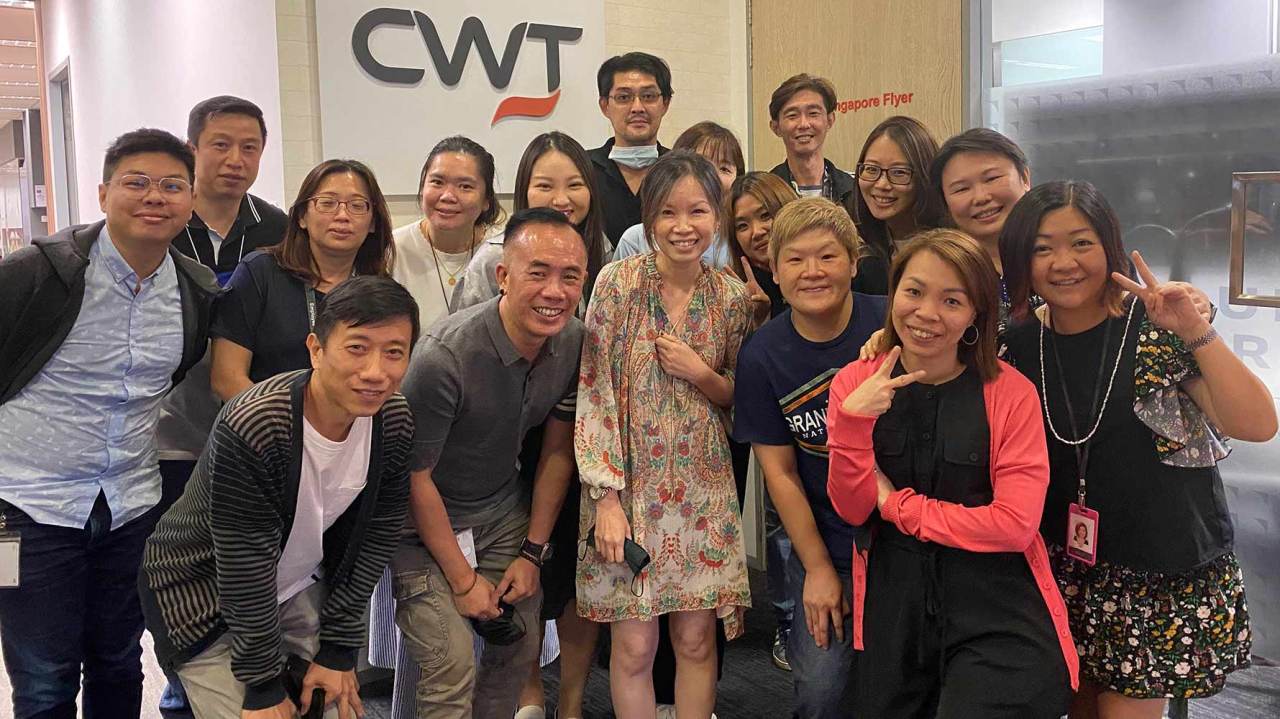
Earlier this year, CWT launched an English-Mandarin bilingual service hub in Singapore, with Alibaba, one of the world’s leading tech firms, becoming the first customer to sign up. The service hub, which operates 24/7, currently supports Alibaba employees based in markets outside mainland China, including Hong Kong SAR, Singapore, Australia, Italy, France, Germany, the Netherlands, the UK, and the US. These employees contact the hub for assistance with their travel arrangements, as well as on-trip support in the event of trip disruptions such as flight delays and cancelations. The results to date have been extremely encouraging.
“We are getting excellent feedback from our employees,” said Jelly Li, Senior Procurement Manager at Alibaba. “Our travelers say they now find it easier to get the support they need because the travel counselors are familiar with our organization’s policies and preferences. At the same time, our Chinese employees who have relocated to other countries love that they can communicate with the travel counselors in Mandarin, which makes them feel more at home.”
Mr Zhong says CWT is seeing a lot of interest in this model from other large Chinese multinationals, with another major tech corporation expected to switch over the bilingual service hub early next year. Looking ahead, CWT is exploring ways to create an even better traveler experience by introducing new technologies that will give our counselors greater insight into travelers’ current and historical interactions with CWT, allowing them to operate more efficiently and effectively.
Image credits: CWT
-
State of permanence? 3 ways your hotel experience may have changed for the long-haul
As business travel continues to recover from the pandemic, travelers are noticing changes – which although may not be new in 2022 – many expected immediate post-pandemic changes to be more temporary. Now it seems many practices could well be something more permanent in the hotel industry in place for at least the next few years.
Safety protocols
When arriving at hotels new safety protocols and promotion of social distancing is often immediately evident, with a greater emphasis on contactless check-in, keyless entry, and sometimes mandatory mask wearing in public areas. There is also a newfound focus on sanitation with hotels directing more resources to disinfect public areas and rooms than providing traditional housekeeping services to ensure the safety of guests and staff.
Even though we have seen a return to pre-pandemic processes with social distancing and mask-wearing no longer relevant in many countries, we are likely to see some permanent change. One key area is the reduction of staffing levels at hotels. During the pandemic, many properties reduced their workforce significantly. With the current high inflation levels worldwide, the expectation is that they will not be moving back to pre-pandemic staffing levels to control ever-rising costs. Many hotels no longer offer housekeeping services particularly for shorter stays or will only offer the services upon request. Travelers may also see a shift in other services and amenities such as limited or even discontinued shuttle services, hotel spas, pools and fitness centers not open to the public and restaurants promoting contactless room service, removing traditional breakfast buffets or having very limited food and beverage services.
Longer stays
Compared to pre-pandemic hotel bookings, we are seeing a change in the habits of travelers. Where short hotel stays were once standard, with travelers usually returning home directly after their meetings, we are now seeing a trend toward extended duration stays, with stays averaging 16% longer in 2022 compared to 2019 trends and nearly 1/3 of business travelers booking longer stays. These longer stays enable the traveler to remain for additional events or connect with more people during one trip. A new focus on combining business with leisure, with travelers spending a few days working and using the rest of the time having a break with their family, is also driving this trend. With more people able to work remotely, multi-purpose travel offers an opportunity to catch up with work during leave while still enjoying time with family.
Shorter booking windows
A change in the immediacy of travel bookings is also evident. In 2019, only 10% of transactions were completed within 0 to 7 days of travel. In 2021 this number jumped to 66% due to the pandemic. Although we seem to be experiencing a more gradual return to pre-pandemic levels in 2022, about 50% of transactions are still completed within a week of travel and nearly 60% are completed within 2 weeks.
Even though we are experiencing a gradual return and expect to reach near pre-pandemic levels within the next couple of years, a full return to previous booking patterns is unlikely in the near future. Despite successful vaccine rollouts and people embracing the new “normal”, some travelers will likely remain cautious about making advance plans. Further variants of Covid-19 will emerge, flu season will play a role as well as a risk of potential new pandemics. These factors, along with increasing rates in a high inflationary market and companies placing even more of an emphasis on sustainability, the hotel stay we once knew is likely to change for the next few years and most certainly some trends will become permanent fixtures
For more hotel industry trends, and tips to future-proof your hotel program download the CWT GBTA Global Business Travel Forecast 2023
Image credits: Adobe Stock
-

Will you marry M&E? Building a ‘forever’ relationship with your customers
Gill Day, Snr. Director Global Sales & Marketing, CWT Meetings & Events on the engagement economy and how to invest in a relationship to make it last for the long-haul.
OK, I’m being a bit forward. How about we just get engaged, forever?
Why? I went to a real-live event the other week, and I fell in love, with everything. The lights, the creativity, the venue, the food, the buzz, the speakers, the inspiring agenda, the entertainment, the making new connections and connecting with the old. On reflection, it really was the connections that made it stand out. And after all, isn’t that what events are all about? Connecting and engaging?
The event was Cvent Connect Europe, one of the world’s largest event technology conferences bringing together meetings, events and hospitality professionals to evolve and inspire their meetings and event programs, and put cutting-edge strategies into practice. It was a well put together, well planned event that enabled attendees to join in person or online (yes I’m avoiding the ‘H’ word on purpose. And no, it’s not ‘honeymoon’).
Hot topics on the agenda and a few takeaways include
- Sustainability – Spoiler alert. We’re not there yet across the M&E industry.
- Digitisation – We’re catching up to the rest of the world, slowly but thankfully, surely.
- DE&I – we have to learn to be more honest with each other.
- Total Event Programs – provide the best return-on-investment, especially for marketeers but there’s a need to invest.
- Creativity – there’s a whole array of creative ideas out there. You just have to look….on YouTube.
I do have a confession to make. As for many of us who attend industry events, I didn’t go to learn about ‘Cvent’ per se. I went for the speakers, to see customers and prospects. I went to engage and connect, yes with the Cvent team but also with the industry’s best. I also went to learn, and if I happened to learn more about Cvent along the way, then that was a bonus. Especially if it was about sustainability and DE&I.
To make it work, you get out what you put in
The engagement, the relationships and connections. The main ‘event’ of an event. If I compare that to our own mission at CWT where we aim to ‘unlock the power of human connection’, what I still see as a problem, or that ‘something missing in the relationship’ it is that we, as organisations, forget about the need to invest. Like a perfect marriage, that ‘happily ever after’ only happens when you invest. Time. Energy. Money. You get out what you put in, and more often than not, companies are not investing in their meetings & events in the right way to organise an engaging event. And attendees are not investing in the right way to get what they want out of the events they go to. So perhaps we need some marriage guidance.
Let’s face it. We’re social creatures. We will never stop being social creatures, so we should think about how we can connect and engage differently, more meaningfully, in this ever-increasingly digitised world we share. It was clear at Cvent Connect that we are becoming more diverse in the industry, more inclusive, and as a result we’re more innovative and finally seeing the digitisation that is proving the return on investment (ROI) story we’ve been talking about for so many years now but been less able to demonstrate.
The engagement economy is finally here for meetings & events and I’m super excited as I’ve been waiting for this day to come. I don’t know about you, but it often feels like the M&E industry is the late starter. We’re finally catching up to the rest of the world. Across the world we’re seeing digital transformation, and the need to connect and engage across multiple channels with the changing way we work, travel, meet and live our lives these days. Relationships are changing, merging, blending, and becoming very different from what they were even three years ago.
Events are changing too. With current tech, they are infinitely more quantifiable than before, engaging attendees up to 20 times across the life of a single event. Compare that with digital marketing where you have 2-3 potential touchpoints to engage someone and surely that is evidence enough that events must be the digital marketing strategy of the future and the reason we need to invest more heavily in events technology and data? Just imagine the value of a customer journey, not just at one event, but across your events programme, year-over-year. That’s invaluable data that can help your organisation grow and adapt to improve your strategy, and you customer relationship.
So, my biggest question is why aren’t more organisations doing more of this? Why aren’t they getting engaged; building those forever relationships with their customers by better understanding their journey through their events programs? Investment is still lacking. In fact, just this week I was asked why there was a charge for data and reporting, why it wasn’t just ‘standard’ across events like across other spend categories. And it really is the unanswered question. It should be. For some reason many haven’t made this connection yet, but I long for the day that it becomes the norm. The future of forever engagements is within touching distance.
Image credits: Adobe Stock
-

Strategic Meetings Management – Ready to “Think Outside the Wheel?”
Steve Jobs said it best: “Innovation is the ability to see change as an opportunity – not a threat.” Business travel and in-person meetings and events are coming back causing many companies to recognize that this is a fantastic time to establish – or reimagine – their Strategic Meetings Management programs. Strategic Meetings Management (SMM) is a disciplined approach to managing meetings and events across an organization. It can help businesses achieve many objectives, from managing costs to mitigating risk and creating a better experience for meeting organizers and attendees.
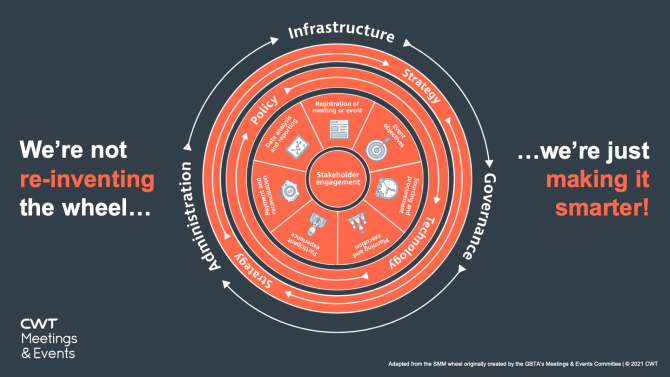
You may already be familiar with the SMM Wheel, created by the Global Business Travel Association’s (GBTA) Meetings & Events Committee, representing the best-in-class standard for managing an enterprise-wide meetings and events program. While the wheel’s 11 components are essential to building an effective SMM program, there is a question that remains: can these components alone help you reach your goals?
Over the years, many M&E leaders and practitioners have discovered gaps in savings and or adoption despite using the wheel as the foundation for their SMM programs. These gaps create difficulty building a business case with senior leadership, gaining stakeholder buy-in, and driving adoption for the program across the organization.
The SMM wheel has provided an excellent framework to build and establish strategic meetings and events programs for decades and will continue to guide solutions that define success within a variety of strategic program models. But what if we start thinking outside of the foundational guidance of the wheel? What can be done to elevate the methodology of the SMM wheel to ensure that your program is getting maximum value as it matures? We believe the answer lies in three unique guiding principles that can be added to the existing wheel today:
- Infrastructure – It is critical to have a program service model that supports the SMM strategy across your enterprise to help you achieve your goals. This infrastructure encompasses the funding model, resource model, service configuration, technology, and suppliers that you should include as part of your program. These are essential considerations to incorporate before implementing any or all 11 components on the wheel.
- Governance – Experienced and tested leadership appointed at all levels of your strategic program will drive change and bolster program adoption by providing oversight, consultation, and guidance. It can be done in a mandated or non-mandated environment. The oversight follows the direction of the corporate culture and objectives to align with the business goals. This supports the policy, compliance, resources, processes, and services associated with your SMM program.
- Administration – Operational excellence boils down to one simple concept – Effective Administration. It is the day-to-day operation and support required to execute your SMM program. It drives demand management strategies and ensures a consistent interpretation of policies and processes such as the intake of registered meetings, maintenance of the technology, the service workflow to maintain fair and balanced resources, supplier market share, continuous process improvement, and training.
Wrapping these guiding principles around the SMM wheel’s components fills in the gaps around program adoption while driving your stakeholders toward smarter buying decisions that support your company’s goals.
What’s more, this approach should be applied to all meetings across your organization. There is a perception that SMM only includes certain meeting types. Very often, small, virtual, hybrid, executive, and incentive meetings and events are left out of SMM program strategies. By including those meetings and events in your design, you immediately increase the leverage and value that your program can yield.
Total Meetings Management (TMM) – the future of SMM
Thinking outside the wheel is what brought CWT M&E to answer the question we hear almost daily from our customers – What’s next for the evolution of SMM? We believe that what’s next is taking the great foundation of the SMM Wheel and elevating the practices by not just envisioning the future of SMM but creating it. The idea of Total Meetings Management (TMM) is not just a statement or a promise. It’s a well thought out strategy with legs, methodology and clear actions that are showing our customer’s a way to include all meetings, not just some, into their plan and strategy. It’s showing them a way forward to gain results, adoption, and real value within their SMM program.
Want to hear more about TMM? Join the movement and let’s talk about how we can make your program TMM ready.
New to SMM and want to learn more, have an existing SMM program but don’t have the adoption you were hoping for, or maybe you are looking to expand into new markets? We can help! Contact our SMM Consulting Solutions Team for more information.
More about Strategic Meetings Management (SMM)
Image credits: CWT & Adobe Stock
-
The Art of Retention and Sun Tzu’s ‘Art of War’: 3 important lessons about keeping clients
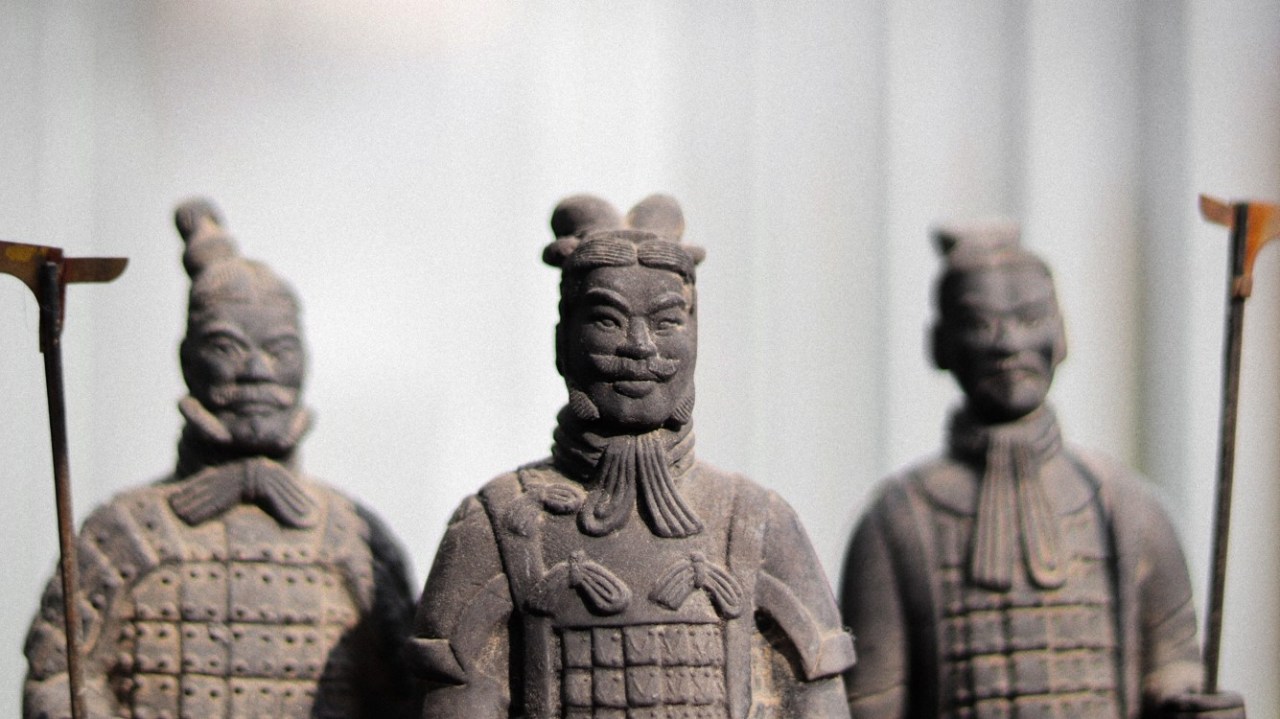
A former global sales leader, I have long been inspired by ancient tome The Art of War by Chinese philosopher and military general Sun Tzu. I lived in the Asia Pacific region for many years, and the influence of Chinese writers and philosophers made even more of impact on me. Sun Tzu’s philosophies are still frequently referenced, not least in relation to business strategy and management.
In my new role as CWT’s Global Head of Retention, I wanted to see whether Sun Tzu has anything useful to apply to the art of retaining clients. As it turns out, we can apply many of his ideas to our customer retention activities.
Retention requires planning, strategy and setting a future vision, not unlike military strategy. Before I draw similarities between Sun Tzu’s Art of War and the art of retention, let’s look at how our client relationships have already changed, and how it is harder to retain customers in today’s world.
In our new world we are already seeing changes to relationship-orientated contract management and escalation processes. Some customers are looking to re-evaluate or renegotiate their contracts. We see more requests for dynamic pricing and flexible financial modelling which in turn changes the need for contract performance management and it resets the goalpost on service expectation and delivery.
Expectations will evolve around travel disruption, destination info, on-trip support, security, and post-trip feedback. This allows for new opportunities for TMCs and could move us toward more traveller-centric performance metrics. We are seeing demand for more traveller centric performance reporting, traveller specific service level agreements (SLAs) and compliance reporting. All this adds complexity to managed travel. And these ‘new’ elements in corporate travel give us opportunities to enhance our customer relationship and challenges the status quo within our existing client relationships, yet at the same time makes it more difficult to retain clients as our customer expect us to be agile, flexible and intelligent.

“Every battle is won before it is ever fought.”
– Sun Tzu
In a recent survey, 88% of buyers said that contract performance has an impact on their decision about whether the incumbent keeps the business. Having the customer on your side when the retention process starts can have a hugely positive impact. What are you doing during the contract process to make sure your customer is on your side and actively wants you to be the contractor for the next contract period before the RFP process even starts? At CWT we start execution of a customer’s retention strategy before the ink on the contract is dry; and our activities ramp up at least 24 months before the contract is up for renewal. This is the best way to be well-positioned and prepared to retain customers.
“The victorious strategist only seeks battle after the victory is won”
– Sun Tzu
Start by putting in place a strategy to ensure that by the time your proposal is due you have put yourself in a position to win. Your customer will be preparing for months prior to the official start of the retention process. They will be making decisions about whether to go out to bid, whether to extend the contract, what their aims for the next contract are, what the scope and breadth of the next contract will be, what the specifications look like, what procurement format they will use, and how (and by whom) the proposal will be evaluated. If you have put the right team in place to implement a plan to ensure you get early knowledge – and if possible, participation in, or influence on – these decisions, you will already have secured yourself a lot of the elements that will help you retain – before the process starts. Client ideation sessions, or workshops, help us identify and pre-empt our customers’ needs now and in the future.
“Whether in an advantageous position or a disadvantageous one, the opposite state should be always present to your mind.”
– Sun Tzu
As the incumbent you should be in an advantageous position. But perhaps the most common complaint from buyers is that they see incumbents as complacent (or arrogant) in how they approach the retention process.
Approach client retention as though you are trying to win the contract for the very first time, and as though you are not the favourite to win and need to pull out all the stops to achieve victory. That will come through in how you prepare, who you put in charge of your retention and what resources and attention your customer gets from senior management, how you approach your solution, and how you write the proposal. Assuming that your victory will be easy is one of the most common catalysts for losing a client.
It’s important to closely evaluate your strengths and weaknesses. How did you perform on the contract, and what from that performance can you use in the retention process to best effect? If there are issues on the contract you need to understand these. What impact did they have on the customer, how did you resolve them, can you use the learning from these issues to inform your new solution? And can you turn the problem around to show that by quickly resolving the issue, you have shown a proactive and flexible approach to anticipate potential problems that your competitors may not have.
By focusing on long-term strategy, anticipating clients’ needs and not taking a single contract for granted, the principles of the art of retention are just as relevant today as on the battlefield of Sun Tzu’s ancient China.
-
RoomIt selected by Amazon as its hotel category management partner
CWT, the Business-to-Business-for-Employees (B2B4E) travel management platform, today announces that its global hotel division RoomIt, has been selected by Amazon to provide comprehensive hotel category services support. This includes sourcing, booking and rate reshopping, whilst helping to increase compliance to hotel policy and optimize Amazon traveler satisfaction.
“We are delighted that the strength of our relationship and offering has been recognized by Amazon and we continue to invest in technology and solutions that allow us to respond to the specific requirements of our clients and, as in the case of Amazon, deliver innovative hotel solutions that help them maximize the value of their business travel spend,” said Belinda Hindmarsh, Chief Growth Officer, CWT.
This win sees CWT further expand its longstanding business travel partnership with Amazon, which also encompasses global air, rail, and meetings & events solutions.
CWT has onboarded US$7bn in new client business over the last five years while maintaining an average existing client retention rate of over 96%, putting a closed loop process in place to ensure the company never rests, but continuously strives to improve its client fulfillment and satisfaction capabilities.
CWT is a leading global partner in business travel, meetings, and events. Operating across six continents, we deliver sustainable, tailored solutions that help organizations connect, engage, and thrive in an evolving world. Our myCWT platform integrates advanced technology with human expertise to simplify travel and enhance traveler and attendee experiences. Extensive global coverage, seamless data integration, AI-driven analytics, and carbon-conscious travel tools enable businesses to optimize their travel and meetings programs while delivering measurable value.
With 150 years of industry experience and a deep commitment to partnership, CWT collaborates with clients to shape the future of business travel and events, making them more efficient, responsible, and impactful.
RoomIt is CWT’s global hotel platform trusted by corporate business, non-profit, and governmental travel managers around the world to source and manage their hotel programs and provide best-in-class content, while delivering savings on their hotel spend. Launched in 2017, RoomIt offers more than 800,000 carefully sourced properties across 73,000 destinations worldwide, offering some of the best exclusively negotiated room rates across the industry and opportunities for customers to save.
-

Data dilemma: Water, water everywhere and not a drop to drink
When I hear companies talk about being “data rich” yet “information poor” or having “knowledge gaps,” this well-known adage comes to mind. But it’s not difficult to see why there is this disconnect when you learn that more data has been created in the last two years than in all of human history. Furthermore 99.5% of the data collected never gets used or examined. In today’s environment, fast, high-quality decisions are needed to outperform peers, and insights are the key to continually empowering decisions. Data alone, especially unorganized data, has little value, but knowledge and wisdom, however, have enormous value.
So what is the connection between data, information, knowledge, and even the higher order of wisdom?
I find the DIKW model helpful in representing the structural and functional relationships between data, information, knowledge, and wisdom. DIKW is shorthand for the data-to-information-to-knowledge-to-wisdom transformation.
How do you progress from Data to Wisdom?
I recently visited Glacier National Park in Montana, USA, and hiked to Grinell Glacier. Let me walk you through my experience transitioning from data to wisdom on this hike, as well as some of the hurdles I encountered along the way.
There is plenty of data available about the glacier, including:
- Coordinates: 48°45′06″N 113°43′39″W
- Area: 152 acres (0.62 km2)
- Altitude: 6,510 feet (1,984 meters).
That data has been organized and assigned context to form information:
- The glacier is named after George Bird Grinnell, who was also a strong advocate of ensuring the creation of Glacier National Park.
- Grinnell Glacier lost nearly 40% of its land area between 1966 and 2005.
- The glacier can be reached after a 6-mile (9.7 km) hike from a trailhead beginning at Swiftcurrent Lake and has an altitude gain of just over 1,600 ft (490 m)
Over time, many hikers and outdoor enthusiasts have processed that information and assigned meaning to form knowledge:
- The majority of the elevation is in the second half of the hike, with a very strenuous section in the last 0.4 miles (0.65km).
- Be aware that bears, moose, and other wildlife are present.
- The trails are rocky, making for a difficult hike.
And finally, insight is added to knowledge to create wisdom, guiding actions and judgments like:
- Hike in a group and bring plenty of water.
- Bring bear spray – and pray you don’t ever come close enough to have to use it.
- Dress in layers and take your time.
So what’s the moral to the story?
Going into the hike I had all the data, information, knowledge, and wisdom available from the internet on the Grinnell Glacier hike. Even with that, I still went down a goat path I thought was the hiking trail, believed every hiker that assured me the glacier was just around the corner (it wasn’t) and thought going back down hill would be easy (it wasn’t).
So here is my takeaway. As you move from data to wisdom, the key is to expect bumps along the way. You’re going to get false positives and it’s going to take longer than you want it to. But the key is to take that first step. In the end the results, and in my case, the view (below), will be worth it.

-

Podcast: How to build a lean, mean meetings machine in a perfect storm of volatility
CWT Meetings & Events (M&E) is an award-winning global events agency delivering live, virtual and hybrid events for thousands of customers every year ranging from end-to-end productions of some of the world’s largest global conferences to intimate teambuilding events.
Kari Wendel, VP strategic and enterprise customers, and global operations is at the helm of the agency’s ‘total meetings management’ approach working with larger customers with centralized meeting strategies, large events & corporate incentives.
An alchemist of process, spend, volume, standards, supplier negotiations, and data to achieve measurable business objectives that align with an organization’s strategic goals, Kari knows the state of the industry more than most.
Find out:
- How record-breaking demand combined with leaner teams, higher costs, fewer options and longer lead times have created a perfect storm and how your organization can weather it with aplomb.
- Why a centralised meetings strategy is critical in the current climate of unpredictability.
- New ways to look at managing risk and how to plan for unknowns.
[buzzsprout episode=’11536495′ player=’true’]
-

Not all carbon measurement methodologies are created equal
CWT partner Thrust Carbon applies a granular emissions calculation methodology that not only gives you an extremely accurate measure of your carbon footprint but that, as a result, maximises your ability to measurably reduce it.
In this guest blog Thrust Carbon Founder and Director Mark Corbett, explores the ins and outs of measuring carbon emissions.
Methodology… I seem to hear that word a lot
That’s not surprising. Businesses are under shareholder, consumer and employee pressure to decarbonise. To measure progress, they need to measure both a “baseline” (the starting carbon footprint) and progress from that baseline towards a target (“50% reduction by 2030” for example). The methodology is the umbrella term for how we get and manipulate input data to arrive at the carbon footprint number.
Why the noise?
When measuring carbon footprint from any business activity, the methodology needs to be consistent. The decisions we make when we do those measurements greatly impact the number we end up with.
For example, if you’re measuring the emissions from a fleet of trucks, do you just measure their direct emissions from burning diesel? Or do you also measure the emissions from extracting and transporting the oil? How about the carbon footprint of manufacturing the new trucks you bought this year?
So as you can see, the devil is in the details! That’s why the noise – not everyone agrees on those key details.
OK, how does this apply to travel? What makes a good methodology for air travel emissions?
Again, the devil is in the details. A good methodology, like the one that Thrust Carbon uses, should account for differences in the following factors:
- Class of travel: A bigger seat means putting more planes in the air to transport the same number of passengers, increasing carbon footprint.
- Flight distance: The further a plane travels, the more fuel it has to burn.
- Aircraft type: Different generations of aircraft create leaps in aerospace technology that boost fuel efficiency.
- Seating layouts: “Business” or “First” class on a short-haul flight look very different to a long-haul flight and the methodology needs to reflect that.
- Occupancy (often called “load factor”): The more full a plane is, the lower will be the emissions per passenger.
- The split between passenger and freight load: The more freight is on the plane, the lower the share of emissions accounted for by the passengers and their baggage. It’s more efficient to put as much payload (freight and passenger) as possible on a single flight, so a low passenger-to-freight ratio will result in a lower per-passenger emission level.
- Radiative Forcing (the higher impact that greenhouse gas emissions have when emitted at higher altitudes)
What difference do those factors make?
Let’s take the Aircraft Type to illustrate this. A newer generation of aircraft can mean a double-digit percent reduction in per-seat emissions. If you can promote two carriers to your travellers on a key route – one flying second-generation and one flying third-generation craft – you probably want to promote the one with the newer model. But for that to deliver a measurable reduction, you need to capture that aircraft type data point and account for it in your reporting.
This stuff seems to be pretty controversial…
Indeed it is. Let’s take a recent story from the BBC about the methodology that Google Flights applies (Thrust Carbon’s Kit Brennan provided his expertise to demystify this one). A barely-announced change to how they account for non-carbon greenhouse gas emissions cut their estimates in half – they removed radiative forcing from consideration.
OK, so I’ve got my checklist. Anything else I should know?
Even the same methodology applied differently can give different results. Whereas Thrust Carbon updates occupancy estimates monthly, if a calculation uses an older estimate it wouldn’t account for the much higher occupancy levels the industry has seen as travel has surged in 2022. For example, the UK government’s published emission factors (commonly referred to as “the DEFRA factors”) are still calculated using 2018 load factor statistics.
Got it! Getting the right methodology from the right place sets me up for success
That’s right. Not all methodologies are created equal – they need to be precise enough that your real-world actions deliver the measurable results your customers and other stakeholders want to see.
If you want to find out more – speak to your CWT account manager today.
-

The life electric: 3 reasons to hire an electric or hybrid vehicle
Like fast fashion and eating meat every day (or at least not admitting to), gas-guzzling cars are becoming distinctly uncool. People are trading in their 4-wheel drive luxury SUVs – known as ‘Chelsea tractors’ in London – for a Tesla. 90s style is back but you’re unlikely to see a celebrity driving a Submarine-esque Hummer without being trashed by their environmentally-conscious TikTok followers.
We’re seeing the rise of the electric vehicle (EV) and what better way to test-drive one of these clean, green, money-saving machines than on a business trip?
Worldwide demand for EVs could grow sixfold from 2021 to 2024 with unit sales increasing from 6.5 million to 40 million, according to McKinsey research.
“Motivated by traveler preference and the call for greater visibility into carbon emissions for global businesses, sustainability and green travel options are moving into the spotlight when it comes to all aspects of the travel selection process,” according to the CWT GBTA Global Business Travel Forecast 2023.
“Charging infrastructure varies hugely across countries and regions and range-anxiety is a very real barrier when it comes to renting an EV. Corporate travel managers are teaming up with companies like CWT to help combat this by signposting local and online resources, providing maps and real time information on where (and how) to charge an electric vehicle.”
Here are 3 reasons to hire an electric or hybrid vehicle:
- Sustainable – Global climate change initiatives – like the EU’s ban on combustion engine cars from 2035 – are playing a part in helping to solve the infrastructure gaps when it comes to speeding up adoption, charging times and increasing charging points, making it much easier for business travelers to do their bit when hiring a car with no tailpipe emissions.
- Wallet-friendly – Driving an EV will lower your fuel costs by up to 80% compared to a petrol equivalent. Good news in an environment of inflationary pressures and rising fuel costs expected to increase the average car hire by 7.3% globally in 2022 and a further 6.8% in 2023.
- Convenient – Drive in low emission zones – perfect for travel across major cities like London. You can also take advantage of free parking in some cities, many of which have charging stations and EV-dedicated parking bays.
Find out more about future trends in ground transportation in the CWT GBTA Global Business Travel Forecast 2023.
- Sustainable – Global climate change initiatives – like the EU’s ban on combustion engine cars from 2035 – are playing a part in helping to solve the infrastructure gaps when it comes to speeding up adoption, charging times and increasing charging points, making it much easier for business travelers to do their bit when hiring a car with no tailpipe emissions.