
Introducing the latest myCWT product and service enhancements
Building on our digital, omnichannel myCWT platform, our new products and services will simplify travel management for you and your employees – anytime, anywhere, anyhow.
Note: Featured services may not be available in your country at this time. Please reach out to your CWT representative for more details.
Hear from Chief Product Officer, Erica Antony as she shares the key product highlights of 2024, along with the key areas driving innovation.
-

2040: Baseline, Boom or Bust
As we enter an era of rapid transformation and unprecedented challenges, it is essential for travel managers, meeting & event planners, and corporate decision-makers to look ahead and frame our current strategic thinking with a clear vision of the future. Business travel and meetings and events (M&E) are poised for significant change over the next decade and a half, driven by a complex interplay of sustainability goals, technological advancements, evolving work models, and geopolitical dynamics.
In this paper to mark the 10th anniversary of our Global Business Travel Forecast, we explore, for the first time, a long-term vision of the future and potential trajectories through three distinct scenarios, each offering insights into how these forces should affect policy-making, budgeting and priorities. By examining these scenarios, we can better understand the diverse possibilities that lie ahead and the strategic imperatives required to thrive in each potential future.
Based on trajectory data analysis and interviews with industry leaders, behaviorists and climate tech founders, this forward-looking approach enables us to anticipate changes, strengthen our strategies, and make informed decisions that align long-term objectives. It is through this lens of foresight and adaptability that we can build resilience, seize opportunities, and navigate the complexities of the future.
We invite you to reflect on the insights presented, and consider how your organization can prepare for the opportunities and challenges that lie ahead. Together we can ensure that travel and meetings remain catalysts for growth, scalability and sustainable practices.
- Scenario development is both an art and a science
- Megatrends Shaping the Future of Business Travel, Meetings and Events
- Sustainability goals the new crux of corporate policy
- Technology Revolutionizes Travel Management
- Modern work models spark new travel patterns
- Changing demographics open doors to new opportunities
- Three Scenarios: Base case, boom and bust
- Future-proofing strategies

-

CWT GBTA Global business travel forecast 2025
When it comes to pricing, global business travel has finally reached an enduring, higher baseline. Prices will continue to rise in 2025, but only moderately, so expect a period of normalized growth.
However, this pricing environment, one of marginal gains and price regularity, is fragile. Global leisure travel has now realized a lot of its pent-up demand, while corporate travel has been resurgent, with 2024 edging at preCovid levels.
There are many factors at play, whether its volatile oil prices, labor costs and constraints, inflationary pressures, and geopolitical factors. As this elevated baseline edges upwards, albeit marginally, travel budgets will come under increased scrutiny, especially as travel patterns and attitudes change.
It’s why business travel can’t be viewed in a silo, and the true value to an organization must be fully realized. This forecast can help with those calculations.
-

Capitalize on emerging technologies in corporate travel
Technological advancements are accelerating at an unprecedented pace. How will emerging innovations like Generative AI, blockchain, and self-sovereign identity (SSI) transform corporate travel?
BTN and CWT probed global CEOs, travel managers, industry consultants and tech experts on the promises, questions, and expectations these innovations raise and how they are set to reshape traveler experience, cost control and service delivery in corporate travel and events.
Download and discover
- The technologies that will have the greatest impact on corporate travel in the next 2-5 years
- How these emerging technologies are poised to control costs, enhance service and security, and boost efficiency
- The critical challenges, opportunities, risks and roadblocks each innovation raises
- What travel managers, buyers and experts anticipate from these innovations
-

On the safe side – Taking a more complete view of safety and security for meetings and events
In an era where the mere mentions of terrorism, viral epidemic, natural disaster, or political unrest reverberate around the world, the topics of safety and security have entered our daily discourse. Meetings and events are no different, realms where the real, practical necessity of protection from harm lands firmly center stage. After all, delegates and attendees must feel free from any perceived or actual risk, liberated from all concerns surrounding their wellbeing. That is easier said than done and ensuring the safety of guests is a complex, multi-layered undertaking, riddled with questions in search of workable answers. What measures can companies in Asia take to ensure the safety and security of attendees? Are these measures enough and if not what improvements can be made?
“There still isn’t an all-encompassing solution to manage safety and security for meetings and events,” notes Sam Lay, Senior Director, Asia Pacific, CWT Meetings & Events. “The measures are simply part of a larger or more generic scheme that arise from likes of insurance coverage. There needs to be more awareness. Safety and security is not at that level yet, where it is part and parcel of planning and we need a few key organizations to set the stage here.”
Typically, points out Petrina Goh, Director, Singapore, CWT Meetings & Events, planners look at travel restrictions and advisories placed on countries and cities by the likes of consulates, ministries and other organizations that assess travel risks, and use these as pointers as to where delegates can and cannot go, “but generally planners don’t look beyond that. It’s very fragmented.”
Yet it is critical that they do. Safety and security requires interpreting many facets, among them variables like general physical health, electoral cycles, weather patterns, security of the venue and its vicinity, fire safety, exit points, doctors, the security team in-house, each of which can play a significant role in the suitability of a destination. Some industries are more sophisticated than others in their interpretation and knowledge of these factors.
“Industries with mature security include oil and gas and pharmaceutical companies,” explains Goh. “Pharma companies usually include emergency hotlines in all event collateral, the emergency number in the city where the event is taking place, and the address of the nearest hospital. We encourage all planners to include this information in their event collateral.”
“There is a culture of safety and security already in industries like oil and gas and it transcends into other parts,” says Lay. He believes that whatever the industry, a planner must go beyond the reactive side of planning and look at what is happening on the ground and on-site during the pre-event phase. “For instance, if you were going to Thailand and Indonesia during election times, you need a very advanced view. We would look at on-site threats and potential routes for evacuation. If you are off-site, the concerns are vastly different from a business-travel city scenario.”

For Aditya Luthra, Security Director, Asia, International SOS and Control Risks, planners face multiple challenges. “Organizations are increasingly choosing to travel and host events outside capital cities or major commercial metropoles, and the access to medical care might be sub-par compared to major commercial centers and the security environment can be more variable.” He also notices a change in the demographic at events, with increasing female and LGBTQ participation, which has implications for how planners address the security considerations for their events. “Organizations have a legal and moral responsibility to provide pre-travel training and knowledge to minimize risk in locations, and protect attendees and delegates from harm’s way as far as possible.”
“We screen tour operators, check their safety records. We have to look at things like whether it is safe to put delegates on a boat or in a cable car. A planner is responsible for the safety of attendees for every minute,” declares Goh. For events in public areas, where delegates might come into contact with city residents, planners need to mitigate risks like pick-pocketing and petty crime. In the end, guaranteeing that safety requires sifting through information that is both macro and micro, from the general level of crime at a destination to ensuring that a venue can cater to a delegate that has a peanut allergy, for instance. And for each scenario, there needs to be a contingency plan, even for destinations that seem completely safe. “There are a lot of considerations in addition to just the destination itself,” mentions Goh. “There is perception with a lot of our planners that if a destination is ok, then everything else is OK.”
Singapore is seen as incredibly safe — which it is — but last year a number of diners suffered food poisoning at a well-known luxury hotel in the Lion City. Nowhere is completely accident-free and planners must be receptive to talk about subjects that might be difficult. “What happens if something does go wrong,” says Goh. “Planners must understand where the liability will fall should things go wrong. The legal and reputation repercussions are big considerations and we notice a move away from the adventurous traveler to the adventurous but cautious traveler.”
Thankfully companies now increasingly strive to show duty of care. “Markets like Western Europe, North America, Australia, Japan and Singapore have strong duty-of-care cultures,” notes Luthra. “In China, India, Thailand, and Indonesia, we are seeing a significant growth in recognition of duty of care among organizations.”
Hotels run through a gamut of procedures with planners to ensure they meet the requirements of an event and their guests’ security. Stanley Ng, Director of Sales, MICE International Sales Office Singapore for Accor, believes it is key to arrange a “prior site inspection and meeting with the meeting planner, as well as involving both safety and security teams of the company and hotel to review hotel’s security procedures and policy.” Other measures include conducting physical checks of passport details when guest check-in, ensuring key card access is only to the designated floor in which the guest is accommodated during their stay, physical and regular patrols by security officers around the hotel for deterrence purposes, and the use of CCTVs for regular surveillance of the hotel premises at all times. Luthra feels that planners should not rely just on branding, but do actual due diligence checks on properties they plan to use for an event. And they should study every component of an event — the hotel, venues, activities and transport between each point.
For an overview of a destination, the best source of information isn’t necessarily the tourist board which has a vested interest to paint a positive picture of the city, region, or country it represents, but national governmental agencies and companies that conduct independent analyses. In Singapore, the Ministry of Foreign Affairs lists travel advisories on its website, dissemination of information that is not designed to instill fear but to show responsibility and allow its citizens to make calculated decisions. For Caitrin Moh, Senior Mice Manager at the Korea Tourism Organization, “on the safety and security in meetings and events, we follow the travel alerts issued by the Ministry of Foreign Affairs, be it in Singapore or Korea.” She points to the reliability of information of such government bodies. “I was in Korea for business trips during the North Korea-South Korea tension in 2015 and MERS in 2016. Daily life and business were as usual, but the media sensationalized the stories. The ministry’s travel advisory publicly shared that Korea was safe to travel to.”

International SOS offers intelligence on medical and travel security risks in destinations around the world. It also provides on-the-ground support such as secured transport, medical assistance and evacuations. Companies often approach it prior to an event for tailored assessments and advice on how to manage any anticipated risks, which factor in the destination, itinerary, travel dates and travelers’ profiles. “We have an app that sends delegates push notifications in real-time about destination-specific medical and security risks, and also provide advice on how they should respond,” says Luthra. And incidents seem increasingly likely to take place, according to the recent Business Resilience Trends Watch 2019 survey by Ipsos MORI. Forty-three percent of the surveyed organizations, including event organizers, said they expect travel risks to rise in 2019, with issues like security threats, national disasters, and extreme weather topping the list. “Preparing delegates and attendees for the risks they might encounter while traveling is important. It is also incumbent on management to know how to respond when an incident takes place.”
Yet, even with all the planning and pain-staking analysis derived from multiple sources, not everything can be controlled. Delegates and attendees often view free time as sacred, moments when they can remain anonymous and have control of their schedule; during those periods, it’s hard for organizers to police their every movement. In such cases, planners should still advise delegates on things like areas that should be avoided or ways to behave in public.
-

10 Tips for managing hotel programs in EMEA
10 Things to keep in mind when working on a hotel program for the EMEA market
When managing a local portion of a large, corporate hotel program, it’s important to think about how your actions support your company’s larger travel strategy and meet local needs.
These tips will help you accomplish both.
1. Identify independent hotels in top markets, and load them into your corporate tools
Your company likely has chain wide agreements with large brands, but they may not meet local travel needs, especially in secondary cities.
In fact, 75% of European travelers report the top reason they make non-compliant bookings is a lack of accommodation options near their worksite.* Utilize other content sources from your travel management company, like their own specially sourced rates or third-party hotel content (i.e. Booking.com or Expedia Partners Solutions), to add more property types to your hotel program.
2. Rely on TMC or other discounted rates for lower volume hotels
If you cannot guarantee at least 150 room nights in major cities or 100 room nights in smaller cities, TMC discounts can be more effective in reducing costs.
Our RoomIt Rates provide up to 20% off best available rate acting as a great long tail to your hotel program.
See the Roomit rates infographic to find out more.
3. Source longer term contracts
When you do have the volume to negotiate fixed or dynamic rates, you may also have the ability to reduce the time spent on RFPs by securing multi-year contracts with your historical hotels.
4. Expect a more manual sourcing process
You may want to check with your TMC’s hotel content offering before jumping into negotiations with a hotel, because RFPs with some independent and boutique hotels often involve picking up the phone to explain rates and other aspects of your negotiations.
Once rates are secured, you can work with the property to publish them to your booking tools using our CRS by CWT or channel manager tool.
5. Design a strategy to deal with the growing loyalty trend
As hotels consolidate and independent hotels have partnered to offer loyalty benefits, we’ve seen a growing interest in accruing hotel loyalty points in EMEA. Today, 62% of EMEA travelers believe they deserve to earn loyalty points when traveling.*
Consider offering Loyalty Booster, a campaign-based incentive program that provides travelers with additional loyalty rewards for booking preferred suppliers within preferred channels.
Read how to increase hotel compliance with loyalty points
6. Give Europeans their breakfast
When booking, European travelers are generally more influenced by breakfast inclusion than any other hotel attribute – more than property type, health club / gym inclusions, and even the hotel’s photos – so don’t skimp on breakfast in your hotel negotiations.
7. Consider allowing non-refundable rates
62% of European travelers would book non-refundable rates if discounts are significant enough.*
Travelers aren’t always wrong to do so. Non-refundable rates can actually be beneficial to your program.
Driving compliance through choice
8. Start using rate re-shopping tools
85% of EMEA travel buyers don’t use rate re-shopping tools,* yet rate re-shopping tools can produce 1-2% total program savings. Since these tools typically rebook similar rates at the same property, they can provide a seamless experience for both you and your travelers.
Ask your TMC about their recommended rate re-shopping tools.
9. Use food and beverage spend in your hotel negotiations
More companies are including food and beverage spend in their hotel negotiations. Since F&B represents a large portion of travel expenditure, it can be effective in justifying discounts. F&B spend can also be used to negotiate discounts at hotel restaurants too.
10. Implement a dedicated mobile booking tool that instills booking confidence in travelers
Two-thirds of the Middle Eastern workforce is under the age of 35, and mobile usage is high among this group.
Booking confidence is boosted when as many rooms and rates are consolidated into one platform or tool as possible, so travelers can be sure they are finding the best possible option.
For example, our myCWT mobile tool provides over 800K properties and consolidates rates from many major sources, thus removing the traveler’s need to shop around.
-

Stop over or push on – Should you take an ultra-long-haul flight?
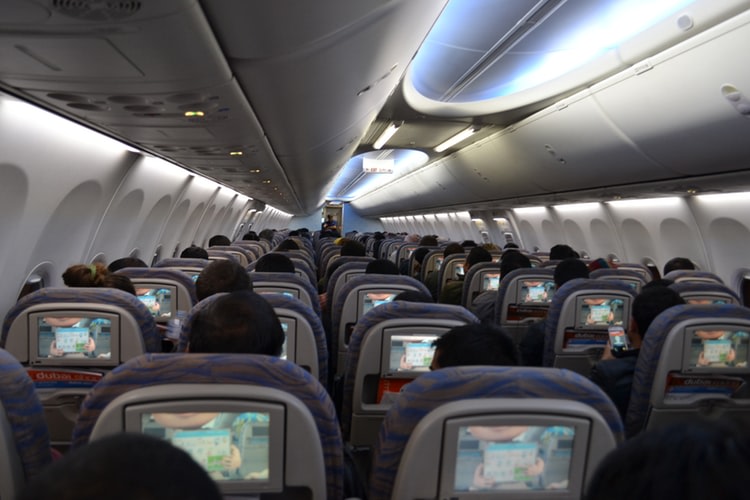
Getting from one side of the globe to the other has never been simpler. Ultra-long-haul (ULH) flights can now leap over half the world in a single bound. But not everyone thinks a 19-hour flight is the best way to travel.
“I would have to be in dire circumstances to not opt for a stop in Tokyo or Doha. If I have to go the other side of the world, my inclination is going to be to break up the trip,” said Mike Valkevich, CWT Vice President of Global Sales and Program Management, Asia Pacific.
He admits he’s in the minority, and the airlines know it. ULH flights have become increasingly popular among full-service carriers over the past few years. The longest is SIA’s Singapore to Newark flight. Qatar Airways now has an Auckland to Doha flight, which is almost as long, while Qantas comes in third with its Perth to London route. It also has flights from Sydney to Houston and Dallas.
Qantas, an airline long accustomed to lengthy routes, hopes to offer direct flights from Sydney to London by 2022. The airline’s CEO Alan Joyce told CNBC that a recent survey of 1,300 passengers found that 80% would be willing to sit through what would be the world’s longest commercial flight, and a large number would be willing to upgrade to business or premium economy to do it.
An 18hr 30min odyssey will test the endurance of some flyers. Still, some airlines are betting big on the success of ULH. But is it the best way to travel?
Why you should take the long haul flight
Speed
If time is the primary concern, a direct flight is hard to beat. Barring a delay, it’s almost always going to be faster than one with a stopover.
“The advantage of it is for people who need to be somewhere as fast as possible. That’s the real crux of it. Some people just want to get the flight component of their trip over as quickly as possible,” said Valkevich.
Avoiding disruptions
If there’s only one leg of the journey, then there are fewer opportunities for an airline to ruin your day.
“When you have traveled for thirty hours to get from this side of the world to the East Coast of the US, and your bags aren’t there, there’s nothing worse,” said Koby Brice, Senior Director, Global Program Management at CWT.
She has twice been separated from her bags, and in both cases it was when they were transferred from one flight to another. The statistics bear this out. A recent report from SITA found that 47% of lost bags go missing during a layover.
Flying direct also eliminates the possibility of a missed connection. CWT Solutions Group’s Business Development Manager for Asia Pacific, Logan LaBonne, said a recent trip from Singapore to Minneapolis became much longer because a delay resulted in a missed connection.
“It changed from a 26 hour trip to a 40-hour trip,” he said.
Avoid airports
If the inside of the plane isn’t terribly appealing, an overpriced magazine and a Danish in an airport terminal might not be so thrilling either. Additional security screenings can be a hassle, and they’re becoming more common for passengers in transit.
“You get off, walk around the airport, kind of aimlessly. And you say you’re going to stretch your legs, but you walk around for 15 minutes, and then you go sit in a chair by the gate for another hour and a half,” said LaBonne.
For those who prefer a stopover, the quality of the airport matters. Valkevich recently traveled from Singapore to Barcelona and found a stopover in Doha was a great opportunity to relax and stretch his legs.
“I stopped over in Qatar, which is amazing, so it’s not a hardship. But there are also many airports where I’d be reluctant to take a long stopover,” he said.
Service
Most ULH flights tend to get good reviews. Full-service carriers depend on business travelers to make these routes profitable. None of them are budget services, so at the very least, the service will probably be good and it won’t be the worst seat you’ve ever had. Also, airlines are doing what they can to make it a little less punishing, with higher humidity and pressurization in the cabin to help fight jet lag and dehydration.
Work and sleep
For those fortunate enough to be able to sleep in their window seat, a longer flight means fewer interruptions.
“With the changing time zones, I like to be able to sleep when I want to sleep, so I can arrive fresh and energized at my destination. If I know in six hours I’m going to have a layover, and in another six hours I’m going to have another layover, then it interrupts that sleep cycle,” said LaBonne.
For others, a long flight is a great place to get some work done, free of the usual distractions.
“You can still do four or five hours. You take a big chunk out of the flight, and you get a whole lot of stuff done,” said Brice.
Why you shouldn’t take the UHL flight
Cost
Airlines typically charge extra for the convenience of flying direct between two cities. These flights usually cost 15-20% more than taking a flight with a stop, and so travelers might be restricted by their companies’ travel policies from booking these flights.
In some cases, they may choose to fly premium economy on a non-stop flight rather than business class on a one-stop flight. But that option isn’t always available. Singapore Airlines’ Singapore-Newark flight, for example, only has premium economy and business class seats.
Pins and needles
Even with decent seats and good service, eighteen and a half hours is a long time to sit in one place. Not everyone wants to watch six full movies without standing up.
“What could they do in the cabin to make it better for me? Nothing that is technologically foreseeable. Make it a cruise ship? No. Go faster? No,” said Mr Valkevich.
Still, many travelers will happily spend a long time sitting in exchange for avoiding hassles in an airport terminal.
“I’m okay for nineteen hours in a metal tube so long as I’m in a comfy seat,” said Brice. But there are limits. She said she’d only take the ULH if she could fly business class.
Is it really direct?
Some bleary-eyed passengers might get off a long-haul flight from Auckland to Doha and then take a connecting flight to Europe. And some travelers flying from Sydney to Dallas take connecting flights to elsewhere in the US. If you need a layover anyway, it’s worth asking whether it’s better to do it after a ULH flight, or somewhere in the middle.
Security screenings
If you’re traveling to the US through Canada, Ireland, several Caribbean airports or Abu Dhabi, it’s now possible to complete immigration clearance before your board the plane. This might make a stopover time well spent before you travel to your final destination.
At the moment, ULH flights are something of a niche category. But it’s clear they’ll become more common over the coming years. They may well be the best option for some business travelers. But even if you’re more inclined to fly direct, it might be worth giving the alternatives some consideration.
-

9 tips for managing hotel programs in LATAM
9 Things to keep in mind when working on a hotel program for the LATAM market
When managing a local portion of a large, corporate hotel program, it’s important to think about how your actions support your company’s larger travel strategy and meet local needs.
These tips will help you accomplish both.
1. Keep your eye on the LATAM market
Although APAC tends to attract more attention, the LATAM region has been turning around recently with 1.2% growth in 2018 and an expected 1.7% growth in 2019. As of 2018, there were over 800 new hotel projects being planned throughout the region.
Even if your company isn’t currently operating in this region, these positive economic signs suggest it may be time to start understanding the unique elements of managing travel in this region.
2. Add independent hotels in your high traffic areas
Like Europe, Latin America relies heavily on small and independent hotels. That means chain-wide agreements with large brands may not be an adequate way of covering your hotel needs in this region. While large hotel brands are beginning to penetrate the LATAM market in places like Mexico, there are many places, like Brazil, where chain hotels represent only about 11% of the total hospitality market.
Utilize other content sources from your travel management company like their own specially sourced rates or third-party hotel content (i.e.Booking.com or Expedia Partners Solutions) to add more property types to your hotel program.
3. Learn local fiscal regulations to save money
In-country, in-currency invoicing that follows local fiscal requirements is very important for tax and savings purposes. Taxes – VAT or IVA in Spanish (Impuestos sobre el Valor Añadido) – paid on travel can be credited against a company’s annual corporate taxes, which means invoicing for each transaction is best done locally.
Some sharing economy services and other lodging providers may not supply this receipt, which is a problem since you need a valid VAT or IVA invoice or relevant Customs receipt to support VAT claims. That can equate to a lot of lost savings when you consider that Colombia, for example, has a standard VAT of 19%. Leverage your TMC to help remind travelers about requesting a VAT compliant invoice, and to provide you, or a supplier, with all the relevant VAT recovery data.
4. Prepayment is popular
Travelers in LATAM and other emerging markets often do not carry credit cards. Prepayment makes travel easy for LATAM travelers, as they can rest assured that all costs are covered ahead of time.
It’s important to utilize payment services that are globally focused and support various payment types. That way companies can provide the same payment experience for their travelers regardless of their regional-specific needs.
5. Expect wide use of travel approvers
Companies operating within LATAM often still take a more hands-on approach managing travel spend. The industry, in general, is moving away from individual approvers due to its inefficiency, so there may be need for a culture change here. That means a lot more education and communication with travelers and managers in this region about how corporate policy and established booking channels can accomplish the same thing in a more efficient way.
6. Mobile is heavily relied on
Latin America is the second fastest growing mobile market, and many countries, such as Brazil, have sizable populations of mobile users who do not own a personal laptop or desktop computer. They are used to relying on phones for internet-based activities. Plus, safety alerts and medical advisories can be automatically distributed via SMS, helping you mitigate against travel risks.
Therefore ensuring your travelers have mobile access and a preferred booking app with a great user experience is pivotal for maintaining high compliance in this region.
7. They like their breakfast hot
Breakfast and hot breakfast are not the same thing in LATAM. Most travelers in this region only consider it breakfast if it’s hot. Many hotels in the region now realize this, but it’s important to remember if you’re negotiating for breakfast inclusion, continental breakfasts will not suffice.
8. It’s hard to stay connected
Premium Wi-Fi inclusion continues to be among the most important amenities for business travelers, yet even basic Wi-Fi isn’t always available at hotels in Latin American countries. This may be why business travelers in Mexico identified Wi-Fi inclusion as the most important determinant when choosing a hotel; more important than distance to worksite, price, breakfast inclusion and even photos of the hotel.
Many travelers won’t have data or roaming services that work when traveling into or between Latin American countries either, so making sure travelers have Wi-Fi access at their hotels is extremely important for this region.
9. Price tracking is for more than just air
A common misconception in this region is that price tracking tools are only for air bookings. Make sure divisions operating within this region know about price tracking tools for hotels and have it turned on. They should know that price tracking tools automatically book similar rates at the same hotels while producing a 1-2% total program savings.
-
10 Tips for Corporate Travel Management in APAC
How your actions support your company’s larger travel strategy and meet local needs
When managing a local portion of a large, corporate hotel program, it’s important to think about how your actions support your company’s larger travel strategy and meet local needs.
These tips on corporate travel management in APAC will help you accomplish both.
1. Traveling within APAC has added complexity
Many countries in Asia Pacific require visas. It is often necessary to hire a driver, even for simple trips from the airport to the hotel. Throw in the unique local regulations, risk of fraud and misuse, and the immense diversity across this region, and you’ll find APAC can be very difficult to manage.
Work closely with experts or TMCs that have in-country experience to plan out your strategy before entering into these immensely complex markets.
2. Mobile adoption is everything in China
Of the 800 million active internet users in China, 98% of those are mobile* users. Today the Chinese do just about everything with their phones from communicating, to ordering taxis, paying rent, and applying for college. Among CWT clients, 90% of bookings in China are made online or with mobile booking platforms.
To support this high mobile usage, it’s important that you or your TMC is partnered with a Chinese based travel technology company such as TravelSky.
Although China is completely immersed in mobile, other parts of APAC, such as Bangladesh or Pakistan, still have lower adoption rates.**
* Source: Forbes “China Now Boasts More Than 800 Million Internet Users And 98% Of Them Are Mobile”
** GSMA “The Mobile Economy Asia Pacific 2018”3. Per diems are heavily used
Per diems are popular in some Asian countries like India and China, but you won’t find them in Singapore, Australia and Hong Kong. Per diems can offer predictability and simplify travel expenses, but it is hard to adapt them equally to every market. Travelers might have too little when going to one city, but too much when going to a different city.
Per diems also incentivize travelers to stay at sub-par accommodations that minimize their expenditure and maximize the allotment they can pocket. The problem is this reduces your ability to influence booking behavior and it puts travelers at greater risk. Work with stakeholders in this region to educate them on the importance of using more policy-driven tools, like rate caps and price optimization tools, to help keep costs low and predictable.
4. Payment is COMPLEX
We discussed the high mobile usage in China, but it’s important to appreciate just how important mobile pay is too. There are restaurants that only accept mobile pay, and even the street vendors prefer payment via cell phone. It may be necessary to have travelers in the region setup WeChat Pay or Alipay, or visitors to the region may have to rely on a local to pay for meals and taxis.
Conversely, in smaller cities in other Asian countries, cash may be the only thing accepted. Although covering hotel rates with per diems might present problems for a travel program, keeping per diems in place for expenditures like food and taxis may still be a necessity.
5. Guest houses will be booked in India
India is the world’s fastest growing large economy in the world.* Hotel supply has been struggling to keep up with demand, so relying on less traditional properties in India is necessary. Guest houses are a very common, and acceptable form of housing for business travelers.
Work with your TMC and content provider in order to identify and upload guest houses into your corporate tools. Due to the nature of this lodging style, it is especially important that they are bookable, and more importantly, trackable through your corporate tools.
Learn more about accommodations in the Indian market
* Source: IMF “2018 World Economic Outlook forecast”
6. Expect to use traditional housing in Japan
Similar to India, Japan also experiences high demand in major cities and low supply in secondary and tertiary cities. Now, with the coming 2020 Olympics in Japan, many hotels have also been temporarily closing to refurbish, further exacerbating shortages. Ryokans (traditional Japanese inns) are being used more often by business travelers going to and traveling within Japan.
It’s a good idea to tell travelers about the appropriate options available to them throughout Japan while also instructing travelers about the proper booking practices. Just be sure people are made aware that ryokans are missing some modern hotel comforts, and that breakfast and dinner are usually included in the price.
7. The GDS isn’t enough
If your only source for hotels are GDSs, then your travelers will find gaps in India, China and Thailand. Adding third-party hotel sources will help fill in those gaps. Even Australia, which is dominated by major chains and is therefore well covered by the GDSs, can benefit greatly from additional hotel sources.
A client was able to increase hotel attachment by nearly 10% in Australia after adopting third-party hotel content from RoomIt.
Additionally, the chain dominance in Australia has made it a very difficult market for negotiations. You may not be able to secure sizable discounts, but you can work to reduce some overall travel costs by including different expenses, like F&B, into your negotiations.
8. Rate policies can vary greatly
Quite often policies can be stricter and operate independently of global policies within the Asia Pacific region. Caps are more rigorously enforced in many cases, and they may be set per title hierarchy as well. This adds an additional layer of complexity if you are used to only setting caps by region or city.
If this is true for your APAC office, consider using tools that allow you to set seasonal cap rates, so you don’t have to waste as much time adjusting caps throughout the year. Start with your highest volume markets and the highest priced cities given prices tend to fluctuate more within higher priced cities. If you aren’t normally setting caps at a city level, you may want to reconsider this for APAC, since, for example, the average hotel rate in Seoul, South Korea is more than double that of Busan.*
* Source: Budget Your Trip
9. Some areas pose high travel risks
Although traveling within most of the Asian Pacific region is normally fine, there are areas that present high risk to travelers.
Be sure travelers know to check security risk levels (South Pacific nations present high travel risk to travelers)* before booking and are aware of safety tips before they take their trip:
- Learn local customs and etiquette
- If you can, start and end your days early to avoid being out at night
- Never walk alone on city streets at night
- Wear more conservative clothing
- Avoid street food and tap water in China, India, Taiwan and Thailand to name a few
- If taking the train, purchase the highest-class train tickets in advance
- Have emergency contact information available
* Source: International SOS Travel Risk Map
10. Be more creative with your sourcing
Considering the complexities of negotiating in this region, it’s a great idea to build a hotel program with longer term agreements and with a more diversified rate mix.
To begin, you should try to secure two-year deals on core hotels to reduce the hours spent negotiating in consecutive RFP seasons. This saves valuable resources and helps reduce sourcing costs.
Next, you should include dynamic pricing for markets with less buying power, or for when you need a quick win. Then trust your agency’s content to help cover the remaining gaps in your program. These parts of your rate mix, representing at least half of APAC hotel programs, covers your lower volume regions where standard fixed discounts won’t provide an optimal return on investment.
To ensure your program is running at peak performance, proactively monitor and manage your relationships with your suppliers throughout the year. Focus on pre-trip transactions so you can understand and plan for cost increases or potential missed savings opportunities, and continuously audit your rates and availability so you can increase inventory before markets become constrained.
-

Eyes on the prize: What’s new with incentive trips in Asia Pacific?
Incentives are a key part of the meetings and events landscape, a powerful tool to motivate the workforce and reward employees for their effort. So what are planners in Asia Pacific doing to keep their incentive trips fresh and interesting?

Far-flung fun
“In the past five years, the biggest change has been the destinations that our clients are willing to travel to,” remarks Petrina Goh, Director, Singapore, CWT Meetings & Events. “People will sit on a plane for 12-15 hours if the destination is right. Before, the maximum was 5-7 hours. Now people will step outside their comfort zone.” Goh points to Eastern Europe and the Baltics as examples of places that Asia Pacific clients are increasingly looking at, instead of focusing solely within the APAC region for incentive trips. “The millennial generation is now taking over the workforce and is pretty well-traveled,” she adds, noting that CWT Meetings & Events has seen interest in Russia, Croatia, Finland, Malta. Though these places are more expensive than Asia-Pacific, companies are willing to spend more as long they get bang for their buck. “It’s also more impactful traveling further and to less-known places,” mentions Goh, with travelers experiencing novel scenery, aesthetics, language, and culture.
Goh’s comments echo a broader shift toward more travel from the region to newer parts of Europe that offer undiscovered experiences for Asian incentive groups. “APAC travelers are indeed venturing further into Europe and to less-trodden destinations,” says Tamas Hanyi, General Manager, APAC Region, Finnair. “We’ve witnessed year-on-year growth in visitors from Singapore to Europe, where the Nordics are a key destination for Singapore travelers in particular. Winter bookings to Lapland are already up by 33% this year. Experience is a new luxury and the best way for companies in Asia to incentivize their teams. We see it as a trend that will only increase.” From its Helsinki hub, the airline flies to cities across Eastern Europe and the Baltics like Dubrovnik, Prague, Tallinn, Budapest, Riga, and Vilnius. “Poland has seen an increase in awareness and travelers from Southeast Asia as well,” he adds.

Push the boat out
For Michelle Sargent, Director CWT Meetings & Events, Australia/New Zealand, emerging destinations are equally appealing for clients. “Australia-based clients are hitting on emerging destinations, bucket-list destinations, and money-can’t-buy experiences. We should be able to offer something on an incentive that a husband and wife or family couldn’t do on their own.” Some places she has arranged trips to include Egypt, Brazil, and Morocco. “These areas are perceived as being very far away, and maybe there is a safety risk involved, but we get the impression from clients that they are willing to push the boundaries if the trip is well organized by a reputable company and offers the highest level of accommodation and security.” One example of a trip of a lifetime that Sargent recalls arranging was in Egypt, a dinner for 120 people in front of the Sphinx.

Idealism and realism
But choosing a new destination to wow employees isn’t as straightforward as sticking a pin in a map. Any incentive trip injects idealism with a healthy dose of realism. Planners will always want to up the ante for the social or meetings elements of an incentive, but it’s important not to pitch plans that are too extreme, and to think in terms of the attendee experience. “Clients need something different beyond four walls. One client wanted to do something in remote Inner Mongolia for 150 guests,” says Goh. “One asked for dinner at the top of a building on a helipad, another to bring a Broadway show or museum into a dinner venue.” Balancing the “wow factor” with the budget and the practicalities of the destination and itinerary is key. At the same time, planners should have a feel for their demographic. “Taking a group in their 60s to a chic beach club in Bali may not be the best option,” muses Sargent.
For Asian travelers visiting undiscovered regions, the pitfalls are real. “Asia-Pacific for an Asian traveler is perceived as a safe choice. Even New York and London are considered common compared to some of Europe and the Baltics.” says Goh. Planners must consider the challenges and risks of opting for a new or unfamiliar destination, and do enough research on a destination before making a choice. This includes factoring in language barriers, infrastructure such as accommodation and public transport, general safety issues like robbery and pick-pocketing, as well as bigger threats of terrorism and the stability of the country. The issue of food is also fraught with complications. “Look at Asia-Pacific, the dietary preferences and requirements are more diverse than North America or EMEA,” explains Goh. “Here you have categorizations such as ‘Indian vegetarian’ and ‘halal’. The menu planning [team] in new regions might not be used to such large, varied incentives group and might have difficulty catering for them,” necessitating an external caterer.
Sargent has similar thoughts. “In countries that are evolving in terms of incentives, sometimes they are not fully equipped to take us on. Some places seem like they are 20 years behind. The destination might have exceptional hotels, beautiful food and people but can feel behind in terms of flow and safety and security. And sometimes they aren’t ready to manage incidents if they happen.”

Costs in check
Budgets are another key concern. Costs need to be kept in check and this requires meticulous planning, especially given additional airfare costs and the implicit assumption from attendees that planners will always look to outdo what they have done in the past. “You need to manage costs, confirm destinations and events well in advance,” says Goh. “You must do site inspections and book hotels well before other people come in and push up demand. If you confirm a trip one year in advance versus six months, you will get a cost savings of more than 15%.” This can be done even further in advance for events that occur like clockwork, perhaps even two years prior, potentially increasing savings further.
Another option to monitor costs is by calculating the choice of the location of an incentive, making sure not to visit a city when major events are taking place, for example. “We would avoid Japan, especially the strip of Tokyo-Kyoto-Osaka next year because of the 2020 Tokyo Olympics. Prices are up 30%. The same for the Dubai Expo. But the rates for 2021 for both drop because of all this inventory. In Beijing, the rates dropped 30-50% after the Olympics.”
Sargent notes that for the incentives that go farther afield, the planner might also cut out some activities or dinner on the second night, and introduce more free time, to rein in expenses.
But planners have started to look beyond just costs, with the view that offering the carrot of an exciting destination might pay off in terms of higher return-on-investment. “With some clients who’ve started taking their employees to destinations in Europe and the Americas, we’ve seen a trend of their groups getting bigger as more people are qualifying for the incentive trips,” says Goh. Post-event, planners should collect feedback from the attendees. Were they satisfied with the content, the meetings, the hotel and the food? “Ten years ago it was difficult to pin down any degree of success,” explains Goh. “Now you can consistently measure satisfaction with delegates. There are tools and data and analytics at your disposal.”
-
CWT research reveals 71% of business travelers embrace innovation
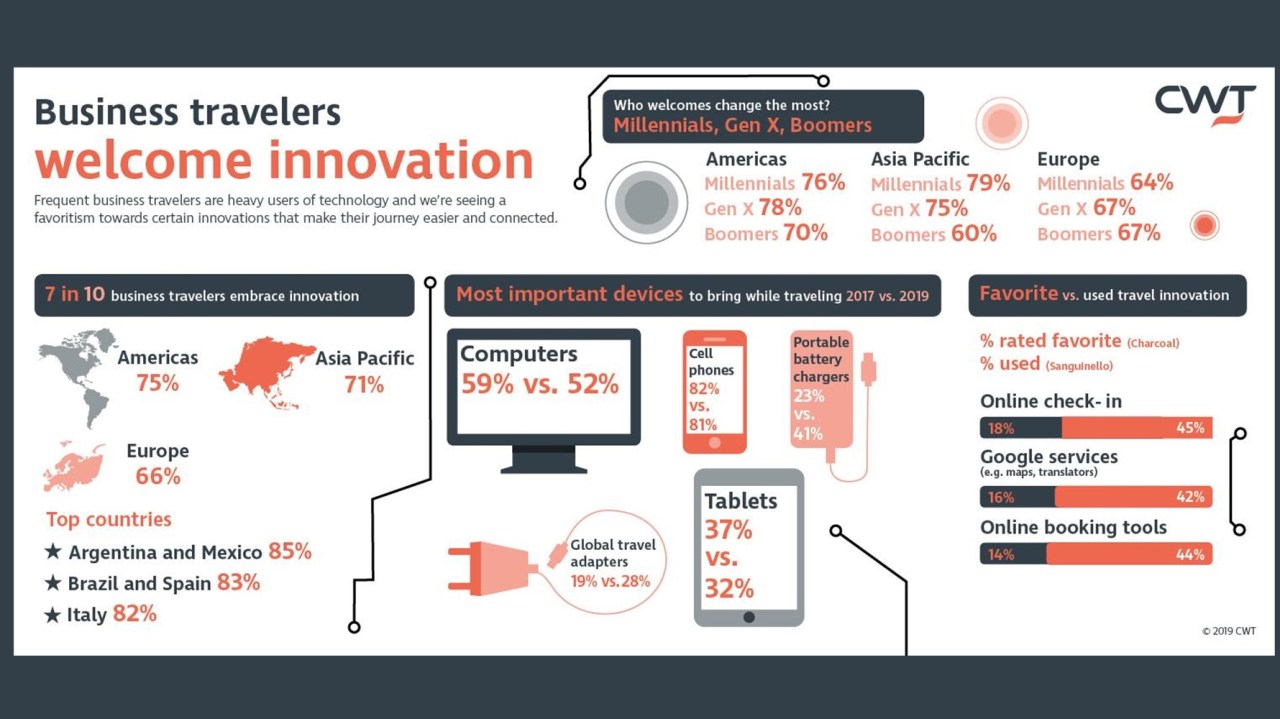
Research by CWT, the B2B4E travel management platform, shows that 71% of global business travelers embrace travel innovation. Travelers from the Americas and Asia Pacific are more likely to favor it, with 75% and 71% respectively. Europeans, on the other hand, are warier of the changes – 7% of them stating a reluctance to embrace travel innovation versus 5% of Asia Pacific and 3% of Americas travelers.
Despite the fact that it is tempting to assume that younger age is a big factor when it comes to innovation acceptance, the results of this survey prove the opposite. Only Asia Pacific millennials score higher: 79% versus 75% of Generation X and 60% of boomers. In the Americas, Gen X travelers lead the way (78%), followed by millennials (76%) and boomers (70%), and in Europe millennials rank last at 64% after the two other generations at 67% each.
“Technological innovation is the future, and frequent business travelers are already benefitting from its potential,” said Andrew Jordan, CWT’s Chief Product and Technology Officer. “Business travelers are people working away from home – so why wouldn’t they want to embrace innovations that make their journeys and their lives easier?”
Top 3 Devices While Traveling
When traveling for business, the top three most important devices to bring along, according to the research, are cell phones (81%), computers (52%), and portable battery chargers (41%). Portable battery chargers have been increasingly favored by travelers since 2017 and have taken over the essential third place from tablets. In 2017, only 23% of global travelers carried these chargers. Tablets have dropped on the packing list from 37% (2017) to 32% (2019).
Smartphones are named among the three most important devices to bring along by 86% of travelers from the Americas, 83% of travelers from Asia Pacific, and 73% of Europeans. Again, Americas travelers score highest when it comes to computers: 59%, but Europeans (51%) overtake travelers from Asia Pacific (48%). The latter are most concerned about running out of power while on the road, with 49% of them bringing portable battery chargers versus 36% of Americas and 34% of Europe travelers.
“Staying connected on the road is not a luxury anymore, it is essential requirement, with the number of devices being less important anymore, but rather how to guarantee travelers can be accessible and feel productive throughout their journey,” said Jordan.
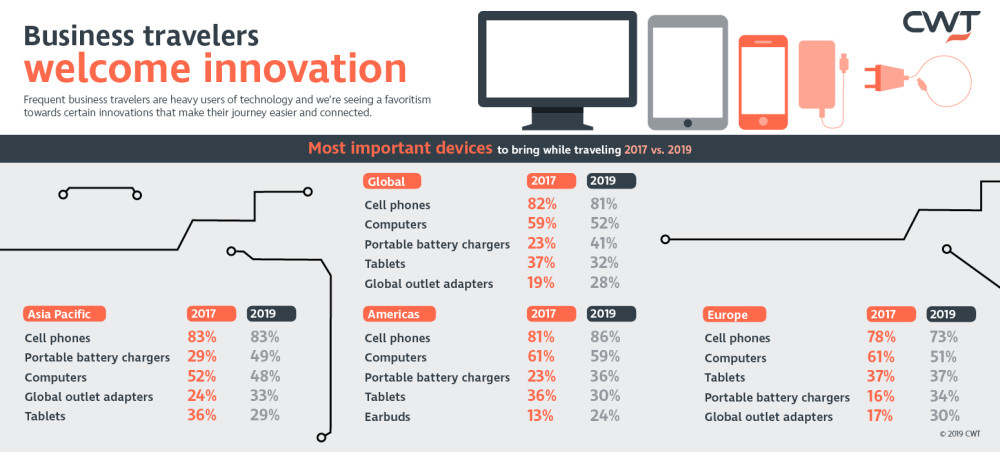
Favorite vs. Used Travel Innovation
Online check-in is both the favorite and most used travel innovation (18% and 45%), followed by:
- Google services (16% and 42%);
- Online booking tools (14% and 44%);
- Mobile travel apps (12% and 41%);
- Fingerprints and retina scans for airport security rather than ID (8% and 16%);
- TSA (Transportation Security Administration) pre-check (6% and 16%);
- Online visa requests (5% and 22%);
- Global Entry (5% and 13%);
- Ride-sharing (5% and 26%); and
- Hotels and/or airports with robot or kiosk receptions (5% and 17%).
Travelers from Asia Pacific show the biggest statistical differences, with 18% rating Google services as their favorite innovation and 50% using them; 15% favoring online booking tools and 49% using them.
47% of travelers from the Americas use online check-in, 43% Google services, and 41% mobile travel apps. TSA pre-check ranks the highest as their favorite innovation (16%).
Europeans show the smallest statistically significant differences, with 26% of them rating online check-in as their favorite and 50% using it.
Note to editor
Top 5 countries that embrace travel innovations the most:
- Argentina – 85%
- Mexico – 85%
- Brazil – 83%
- Spain – 83%
- Italy – 82%
CWT is a leading global partner in business travel, meetings, and events. Operating across six continents, we deliver sustainable, tailored solutions that help organizations connect, engage, and thrive in an evolving world. Our myCWT platform integrates advanced technology with human expertise to simplify travel and enhance traveler and attendee experiences. Extensive global coverage, seamless data integration, AI-driven analytics, and carbon-conscious travel tools enable businesses to optimize their travel and meetings programs while delivering measurable value.
With 150 years of industry experience and a deep commitment to partnership, CWT collaborates with clients to shape the future of business travel and events, making them more efficient, responsible, and impactful.
-

Back to the future: How to predict your way to a better traveler experience
Sometimes, business travelers just run into bad luck. Their preferred flights have no seats available, so they have to take one with a 10-hour layover. The hotels close to the meeting location are priced out of budget. And when they get to the airport, they find their flight has been canceled.
But what if it wasn’t just down to luck? What if travelers and travel managers could see potential obstacles before they turn into a problem – and then take corrective action?
A lot has been said about how predictive analytics can help companies save on their travel spend. But there are also many potential applications in creating a more stress-free and productive experience for business travelers. Here are three examples:
- Predict fluctuations in demand –Often, business travelers need to go somewhere at short notice, only to find that the city is booked solid. There might be a big conference or major sporting event taking place, or it could just be prime tourist season.
Their regular hotels – the ones near the branch office with good transport links and business facilities – are more expensive due to peak demand and priced well above the rate cap set by their company. This means they’ll probably spend a lot of time reading reviews and weighing alternative options in the hope of finding something that looks halfway decent and still falls within their travel policy. And because these options might be further away from where they need to be, they’ll waste time getting around too.
Predictive analytics could help travel managers anticipate changes in demand and introduce variable rate caps. Algorithms will predict price increases, and rate caps can be raised accordingly. At the same time, rate caps could be lowered during the off-season when prices go down. So if an employee’s traveling to Madrid during the Champions League final, for example, they’ll have a few extra dollars to spend to get a hotel that’s convenient. - Predict changes in supply – The airline and hotel industries are rife with change. Mergers and acquisitions, new alliances, strikes, bankruptcies and a myriad other factors can change the options available to travelers.
With the power of data science, companies can get better at predicting how these changes in the supplier landscape will affect their travel programs, and minimize the impact on their travelers. CWT Solutions Group is already experimenting with such algorithms.
While recently carrying out a supplier review for a client, we identified that their preferred airline was about to decrease the number of flights it operated between Paris and Hong Kong, one of the client’s top routes. We gauged how much prices on the route would increase because of the reduction in capacity, and what this would mean for the client’s travel spend.
We also analyzed whether it made sense to change preferred carriers. For instance, moving to a different airline could result in a drop in traveler compliance, because many of the client’s frequent travelers had attained a high status and were loyal to the existing airline.
After conducting a thorough analysis, a decision was taken to blacklist the preferred supplier and choose an alternative. The client did an in-flight product review of the new airline to ensure it was up to scratch, and they negotiated frequent flyer status matching to ensure their travelers wouldn’t lose their perks as a result of the switch.
In this instance, predictive analytics helped a company take a more proactive and forward-looking approach to safeguarding their program in the face of a changing supplier landscape. - Predict flight disruptions – Flight delays and cancellations can be a miserable experience. In fact, research by CWT found that delays are amongst the biggest stress triggers for business travelers. The good news is that this, too, is a problem that the data geeks are working hard to solve.
Lumo, one of the tech startups that CWT is working with, uses predictive analytics to identify delay patterns across millions of flights to forecast disruptions. Their prediction models change as a flight gets close to its departure date. Further out, they factor in the historical on-time performance of an airline, seasonality, and the day of the week and time of day that the flight is operating. Closer to the travel date, the models begin to consider things like flight paths and air traffic, congestion at various airports, and weather forecasts.
Lumo then rates flights to indicate how “risky” they are with respect to being delayed. The rating captures both the probability of a delay occurring, as well as the length of the delay.
Savvy travelers might know how to avoid some of these problems. They might, for example, already be aware that a major sporting event is coming up in a city they plan to visit. But travel isn’t a routine occurrence for everyone, and even the most road-weary business traveler won’t know everything.
Predictive analytics holds great promise for business travel, in that might provide new answers to one of our industry’s perennial conundrums – how to create a more pleasant and productive traveler experience while saving money at the same time.
Image credits: Adobe Stock
- Predict fluctuations in demand –Often, business travelers need to go somewhere at short notice, only to find that the city is booked solid. There might be a big conference or major sporting event taking place, or it could just be prime tourist season.
-

Giving air time to end human trafficking
Tony Wagner, VP for the Americas at CWT Meetings & Events sat down with Cody and Brooke from the Cvent podcast ‘How Great Events Happen’, to discuss our role as industry professionals to help put an end to human trafficking.

The Carlson Family Foundation and CWT have a long history of advocacy and investment in bringing an end to human trafficking. This podcast highlights the impact CWT Meetings & Events, our industry overall, and even attendees at events can make in ending this atrocity.
What to listen for:
- What is human trafficking?
- How to look for signs as it happens in ‘plain sight.’
- Busted myths about human trafficking.
- The reason this impact meetings and events.
- How to train staff to watch for key signs.
- A clear program impact: 35M impressions and 15,000 trained via support from Carlson in 2018.
- Create a plan and ask about vendor policy.
- Be on the lookout, train yourself, and train others.
Now with our involvement, CWT Meetings & Events team and I are committed to support the Carlson Family Foundation, CWT and CWT Meetings & Events, in bringing an end to human trafficking.”
-

The price is right – 5 ways to boost your travel program savings
It’s likely you’re already using a travel program solution that searches for lower rates on an already booked flight and hotel reservation. If you are, are you squeezing the most savings out of it?
First, let’s start by looking at the capability of the tool itself. Price optimization services automatically work behind the scenes to find you the best possible price on your reservations, without causing any disruption to travelers or changing the quality of a booking.
So what kind of solutions are out there? Our new pre-ticket price optimization is an AI platform that can predict airfare volatility, helping save you money by optimizing the time of ticketing. If a pre-ticket identifies a fare that is likely to decrease in price, it places a temporary hold on the booking in order to ticket at the most optimal time.
There’s also post-ticket price optimization which automatically searches for price drops using the same flights, hotel properties, and travel dates as the original booking. When it finds net savings, the flight or hotel is rebooked at the lower price – with no traveler intervention required.
Now, the question remains: Are you getting the most out of your program? Here are some tips on how you can increase your savings:
- Fill in the gaps – Are you currently searching for lower rates for flight and hotel reservations with your price optimization solution? If not, you can easily add up to 2% in savings by adding hotel or flight reservations to your program.
- Look outside the void – By price shopping outside of the void window, you can increase your savings on flight reservations. Features like price optimization could increase your existing price shopping, air savings by 25%.
- Don’t withhold volume – Send as much volume through a price optimization program as possible (don’t omit travelers and keep minimum savings thresholds low). This will allow you to achieve the maximum level of savings.
- Expand globally – Are you using your solution in all possible markets? We’ve seen an average savings of 2% on travel spend in every market our clients did business in.
- Search for lower rates after booking but before ticketing – In addition to searching for lower fares after ticketing, you can also search for lower fares before ticketing. Expand your search and lower rates may follow.
Armed with these tips and tricks, you can push the limit of your travel savings. The power’s yours.
Image credits: Adobe Stock
- Fill in the gaps – Are you currently searching for lower rates for flight and hotel reservations with your price optimization solution? If not, you can easily add up to 2% in savings by adding hotel or flight reservations to your program.
-

FIS Ski Championships partners with CWT M&E
CWT M&E Italy are proud and honored to announce that Cortina 2021 Foundation chose us to be a partner in hosting this new prestigious international event. FIS Alpine World Ski Championships 2021 is without a doubt the most important sporting event taking place in Italy over the next three years, and we will ensure it is a great success. After all, it is not just about the sport, it is also the experiences, passion, and raw emotions – it is in our DNA.
Going back to June 2016, the FIS – Fédération Internationale de Ski Congress were in Cancun, Mexico. Where they chose Cortina d’Ampezzo, Italy, to be the hosts of the Ski World Championships 2021. Bringing the iconic winter sport back to the much-loved Dolomites, which is no stranger to the championships having hosted back 1932 and 1956 as a part of the World Olympic Games. It is a great opportunity for us at CWT Meetings & Events to display our “know how” and expertise in various sporting events, after the 2018 ISU World Figure Skating Championships in Milan.
The championships predicts a large number of attendees and athletes from more than 70 countries over 14 days, requiring a large amount of support and smooth execution. As a result, we have organized the accommodation needs of participants, thanks to a collective agreement with the Cortina Hotels Association. In addition, our specialized sports team, CWT M&E Sports, will take care of the end-to-end organization of the event. As part of the development to drive improved infrastructure to support the event, there will be the addition of sustainable development and the use of renewable energy. As for the ISU World Figure Skating Championship, we are building a platform each stakeholder can engage through to create extensive value.
On the #RoadToCortina2021, I look forward to making CWT M&E the major team players over the next year and a half, supporting and fully executing an exciting and show-stopping event. One that will leave attendees and athletes with great memories for years to come. I am sure it will be a great experience!
Image credits: Adobe Stock
-

Cab or app? Business travelers in Asia Pacific have mixed feelings, but corporate travel programs show openness to ride-sharing services
When you arrive at an airport in an unfamiliar city, do you join the line at the cab rank, or do you reach for your phone? According to a survey by CWT, the preferences of business travelers in Asia Pacific vary widely. It seems the majority of travelers from Japan, China and Australia choose taxis, while those from India and Singapore lean towards ride-hailing apps.
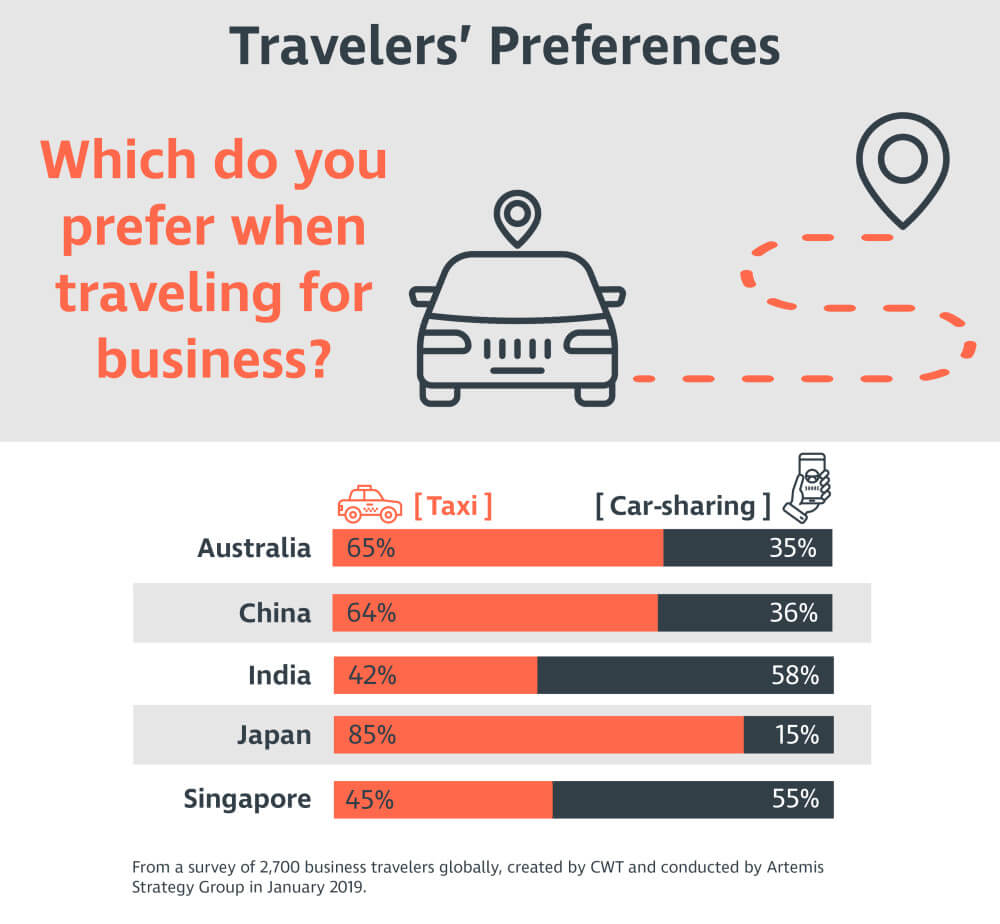
These numbers may come as a surprise, considering the widespread adoption of ride-sharing services like Uber, Grab, Didi Chuxing, Go-Jek and Ola in this region. In fact, a study by ABI Research states that Asia is the world’s largest ride-hailing market, accounting for over 70% of trips globally in 2017.
But while the familiarity and convenience of ride-hailing apps is a big draw for some travelers, for others, hurdles such as the hassle of downloading a new app, language barriers and safety concerns when traveling may make taxis the more sensible choice.
“If you frequently use Grab or Gojek to get around Singapore and you’re traveling to Jakarta where you can use the same app, you might be inclined to do so,” said Bindu Bhatia, CWT’s Managing Director for Asia Pacific. “But if you’re going to Shanghai and have to set-up a new app in a different language, would you go through the trouble? Perhaps not.”
Corporate travel programs give ride-sharing the green light
When CWT asked travel managers in Asia Pacific about their travel policies around ride-sharing, the overwhelming majority said their organizations permit the use of these services for business travel.
The convenience, the pricing transparency and in many cases the cost means that most organizations in the region have come around to the idea. In Singapore, Japan, Australia and Hong Kong, 87-89% of travel managers who responded said their companies allow employees to use ride-sharing services. However, the numbers are slightly lower in China (80%) and India (79%).
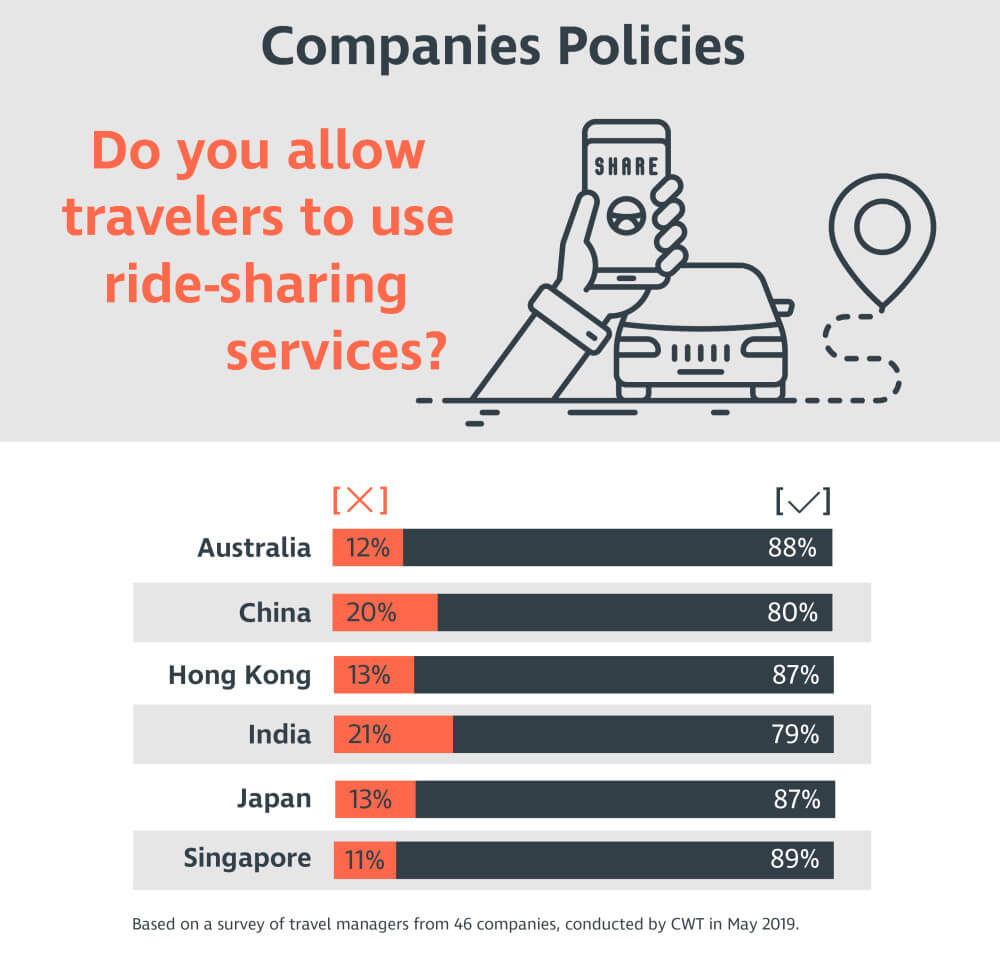
“It looks like most companies are willing to let travelers make the choice (between taxis and ride-hailing services), unless they’ve got a situation where there’s a demonstrable safety differentiator,” said Elis Kodra, CWT Solutions Group’s Asia Pacific Director.
Safety is still an area of concern
If there’s one sticking point, it’s traveler safety, which remains the key concern.
Overall, business travelers don’t seem to think one is much better than the other. A CWT survey from 2018 found that business travelers tend to feel almost as safe using a ride hailing app as they do using a taxi. Forty-three percent of business travelers from Asia Pacific surveyed said they feel somewhat or very vulnerable about their personal safety in ride-sharing services, compared with 39% for taxis.
Women tend to be more concerned about both, and the difference is a little more pronounced. Looking at ride-sharing, 56% of women responding in the Asia Pacific region said they feel very/somewhat nervous about ride-sharing, while 48% worry about taxis. For men, it’s 38% and 35% respectively.
But the widespread publicity surrounding various accidents and attacks involving ride-sharing providers have prompted these companies to put more stringent safety measures in place.
Uber, Grab, Ola and Didi have all added emergency buttons in their apps, as well as ride-tracking which allows passengers to share their trip and location in real-time. In September last year, Didi introduced in-trip audio recording. A month later Grab announced it would double its investment in safety by the end of 2019, introducing new initiatives and features such as using data from the app to measure driver fatigue.
Ride-sharing services becoming more business-friendly
Ride-sharing companies have seen the tremendous growth opportunity that corporate travel represents for their businesses. In addition to beefing up their safety efforts, nearly all the major players – including Uber, Grab and Ola – have launched services targeted at corporate customers, which allow travel managers to set ride policies, automatically pay for journeys and keep close track of expenses.
But ground transport remains largely unmanaged by corporate travel programs in the region, according to Mr. Kodra. “This is an area where organizations may feel it’s very difficult to create and enforce policies, and sometimes the rewards aren’t perceived as being great. In reality, it’s not much different from managing an air or hotel program, and there’s a lot of potential to drive savings and manage risks.”
“The first step is to capture data around your travelers’ usage of ride-sharing services, either through credit card statements or expense reports. That’s already half the battle won. You can then start identifying opportunities to work with these suppliers, and also spot the red flags in high-risk locations.”
Once companies have a handle on the data, the next step is to establish some guidance and boundaries for their travelers.
“It’s generally a good idea to give travelers choices, provided they are coupled with clear policies,” said Ms. Bhatia. “You should factor in your organization’s corporate culture, traveler demographics and risk management policies, among other things. Then create policies that define if, when and how travelers can use ride-sharing services, and communicate these to your travelers.”
Image credits: CWT & Adobe Stock