
Introducing the latest myCWT product and service enhancements
Building on our digital, omnichannel myCWT platform, our new products and services will simplify travel management for you and your employees – anytime, anywhere, anyhow.
Note: Featured services may not be available in your country at this time. Please reach out to your CWT representative for more details.
Hear from Chief Product Officer, Erica Antony as she shares the key product highlights of 2024, along with the key areas driving innovation.
-
2040: Baseline, Boom or Bust
As we enter an era of rapid transformation and unprecedented challenges, it is essential for travel managers, meeting & event planners, and corporate decision-makers to look ahead and frame our current strategic thinking with a clear vision of the future. Business travel and meetings and events (M&E) are poised for significant change over the next decade and a half, driven by a complex interplay of sustainability goals, technological advancements, evolving work models, and geopolitical dynamics.
In this paper to mark the 10th anniversary of our Global Business Travel Forecast, we explore, for the first time, a long-term vision of the future and potential trajectories through three distinct scenarios, each offering insights into how these forces should affect policy-making, budgeting and priorities. By examining these scenarios, we can better understand the diverse possibilities that lie ahead and the strategic imperatives required to thrive in each potential future.
Based on trajectory data analysis and interviews with industry leaders, behaviorists and climate tech founders, this forward-looking approach enables us to anticipate changes, strengthen our strategies, and make informed decisions that align long-term objectives. It is through this lens of foresight and adaptability that we can build resilience, seize opportunities, and navigate the complexities of the future.
We invite you to reflect on the insights presented, and consider how your organization can prepare for the opportunities and challenges that lie ahead. Together we can ensure that travel and meetings remain catalysts for growth, scalability and sustainable practices.
- Scenario development is both an art and a science
- Megatrends Shaping the Future of Business Travel, Meetings and Events
- Sustainability goals the new crux of corporate policy
- Technology Revolutionizes Travel Management
- Modern work models spark new travel patterns
- Changing demographics open doors to new opportunities
- Three Scenarios: Base case, boom and bust
- Future-proofing strategies

-

CWT GBTA Global business travel forecast 2025
When it comes to pricing, global business travel has finally reached an enduring, higher baseline. Prices will continue to rise in 2025, but only moderately, so expect a period of normalized growth.
However, this pricing environment, one of marginal gains and price regularity, is fragile. Global leisure travel has now realized a lot of its pent-up demand, while corporate travel has been resurgent, with 2024 edging at preCovid levels.
There are many factors at play, whether its volatile oil prices, labor costs and constraints, inflationary pressures, and geopolitical factors. As this elevated baseline edges upwards, albeit marginally, travel budgets will come under increased scrutiny, especially as travel patterns and attitudes change.
It’s why business travel can’t be viewed in a silo, and the true value to an organization must be fully realized. This forecast can help with those calculations.
-

Capitalize on emerging technologies in corporate travel
Technological advancements are accelerating at an unprecedented pace. How will emerging innovations like Generative AI, blockchain, and self-sovereign identity (SSI) transform corporate travel?
BTN and CWT probed global CEOs, travel managers, industry consultants and tech experts on the promises, questions, and expectations these innovations raise and how they are set to reshape traveler experience, cost control and service delivery in corporate travel and events.
Download and discover
- The technologies that will have the greatest impact on corporate travel in the next 2-5 years
- How these emerging technologies are poised to control costs, enhance service and security, and boost efficiency
- The critical challenges, opportunities, risks and roadblocks each innovation raises
- What travel managers, buyers and experts anticipate from these innovations
-

Siemens Gamesa signs new global partnership with CWT
CWT today announces that Siemens Gamesa Renewable Energy, a global market leader for renewable energies, has awarded CWT the management of its global travel and meetings & events program, following a competitive request for proposal (RFP) pitch process. After a five-year Spanish corporate travel partnership, CWT now will underpin all global business travel, meetings & events, and hotel solutions for the entirety of Siemens Gamesa’s global travelers, spanning 50 markets.
“We were looking for excellent global and local service models to support our key hub settings, alongside strong and flexible offline and online booking platforms. CWT more than demonstrated its ability to meet this brief, whilst also showcasing strong credentials in global tech innovations and enhanced traveler experiences which will be essential to our evolving business needs,” said Maria Gonzalez Larrainzar, Global Travel Manager Siemens Gamesa.
“We are proud to be working with Siemens Gamesa across the globe. In an increasingly complex corporate travel market, our aim is to furnish them with the tools, resources, services and information they need to make their travel and meetings processes both simple and streamlined, enabling them to focus on their main imperative of leading the way for a sustainable future with comprehensive recyclable commercial energy,” said Nick Vournakis, Chief Customer Officer at CWT.
CWT is a leading global partner in business travel, meetings, and events. Operating across six continents, we deliver sustainable, tailored solutions that help organizations connect, engage, and thrive in an evolving world. Our myCWT platform integrates advanced technology with human expertise to simplify travel and enhance traveler and attendee experiences. Extensive global coverage, seamless data integration, AI-driven analytics, and carbon-conscious travel tools enable businesses to optimize their travel and meetings programs while delivering measurable value.
With 150 years of industry experience and a deep commitment to partnership, CWT collaborates with clients to shape the future of business travel and events, making them more efficient, responsible, and impactful.
-

Podcast: How to spot the signposts of change in business travel
It’s a rare moment when headlines aren’t awash with news of inflation, geopolitical hair-raisers, and the race to combat climate change.
If only there was a crystal ball to help companies plan their business travel and events around uncertainty.
Internationally-recognized thought leader, NY Times bestselling author, futurist, and top-rated keynote speaker Dr. Shawn DuBravac delivers pragmatic and provocative insights on the trends, technologies, and paradigms transforming the globe.
Hot on the heels of his predictions in the GBTA CWT Global Business Travel Forecast 2023 that reveals global and regional price projections and analysis for airfares, hotel rooms, and cost-per-attendee (meetings & events), DuBravac speaks to CWT Communications Chief Julian Walker about the critical issues that could influence pricing and how we travel & meet in 2023.
Find out:
- Is a global recession inevitable and what would one mean for the price of hotels, airfare, care hire, and meetings & events?
- How the macroeconomic outlook could materialize differently around the world.
- How corporates and organizations can reconcile uncertainty with budget planning.
[buzzsprout episode=’12144539′ player=’true’]
-

4 top tips to help make your hotel program work better for you
Following on from my earlier post on how travel managers can maximize the potential of their hotel programs, I want to look at those 4 key opportunities in a little more detail and show how travel managers can achieve both their strategic program goals and give their travelers what they want.
1. Match your booking displays with your hotel sourcing strategy needs
Once sourcing is completed and audited rates loaded, the display should be augmented by the integration of TMC negotiated consortia rates and non-GDS content to enhance relevant choice – and, based on our search data analysis in 2022, such a move improves rate availability by approximately 15%.
Based on past shopping behaviors, and where increasing hotel attachment is a desired outcome, surfacing more relevant properties and rates can help increase attachment rates by up to 5%.
If the need is to increase client-negotiated rate usage, (and again this is based on our data), by using automated continuous audits of client-negotiated rate availability and rate competitiveness against multiple hotel sources leads to targeted supplier conversations, we saw an increase in preferred hotel bookings of up to 13%.
2. Distribute your program consistently across all points of sale
When growing up we had a family saying that went: “inconsistency is the mother of missed opportunities,” and never has there been a better example than in the hotel category.
Consistent hotel content across all tools means that local programs and policies do not need to be built separately, instead global category goals can be set with matched local objectives, meaning travel managers receive better data on their total category spend – all of which lead to improved reporting and greater insights. And, as anyone who has ever negotiated anything knows, greater insights lead to better conversations, enhanced leverage and outcomes.
3. Check that your written hotel travel policy matches your desired outcomes
We are already seeing high occupancy rates and sold-out situations, especially in large business cities – despite hotel rates being predicted to rise 8.5% this year, on top of an 18.5% increase in 2022. This underlines the need to regularly refresh travel policies to achieve both current and tight sourcing compliance, and traveler experience goals.
Our own analysis in Nov/Dec of last year shows client-negotiated rates were sold out more than 20% of the time and that customers using the above approaches were able to augment their hotel supply and saw the use of client-negotiated rates rise by 3.5% for the same months vs the previous year.
4. Ensure alignment between your rate re-shopping/-booking and point of sale parameters
Many hotel programs still have mis-aligned point of sale and rate re-shopping/booking parameters, but simply by addressing that one issue, travel managers can expect to improve program effectiveness before they even get to re-shopping.
The hotel landscape is changing, and so adapting your strategy to be more progressive and flexible is fundamental to ensure your program remains competitive and effective throughout this year.
According to Chinese astrology, 2023 is the year of the rabbit, whose characteristics include being alert, skillful, and responsible. So, if you do nothing else after having read this post, why not embrace those traits and review your hotel policy statements, check your point of sale booking configuration set ups, and ensure that the re-shopping and re-booking parameters are in alignment?
Image credits: Adobe Stock
-

Lights, Camera, Action: Go behind the scenes of the world largest events, sporting teams, and entertainment projects
The recent world cup, all controversy aside, certainly wasn’t short on spectacle. Which, in todays oversaturated content market, is the name of the game. The biggest movies, TV shows, sporting contests, and live events rely on spectacle to attract fans and drag them away from the other forms of entertainment that we have at home.
Today’s market calls for more. More excitement and more spectacle, which means more work to make these occasions possible and more moving parts and people that require keen logistical expertise. It’s more than simply booking hotels or securing flights. It’s ensuring that a team has the right training facilities wherever they may travel to ensure they can perform at their best. It’s ensuring that every member of a film crew, and their equipment, arrive safely at a location to shoot the finale of the next big block buster (like the work we do with Paramount).
Behind the glitz and glamour are people, like our very own Kelley Fosdick and Francesca Rigamonti.
“Managing 1,300 international athletes’ accommodation needs during a pandemic, is an endurance sport in itself. We believe success comes from focus, prioritization and teamwork – so this was a walk in the park for all concerned. This expertise is key for large groups that we are managing especially in the media, entertainment and sport industries.”, says Francesca, Head of Events Operations, Italy and Germany at CWT Meetings & Events.
“We move with a sense of urgency and use dedicated, experienced teams who are knowledgeable on the various nuances in media, entertainment and sports travel” says Kelley from CWT’s Media, Entertainment and Sports customer team. Supported by a team of elite travel consultants, this global team are ready for anything that comes their way.
In short – these spectacles that we crave and love so much – can only happen with the help of dedicated and creative people, whether they’re centre stage, behind the camera, or in an office at a desk many miles away.
Find out more about the work CWT does in the media, entertainment and sports industry.
-

CWT appoints Global Head of Environmental, Social, and Corporate Governance (ESG) & Employee Experience
CWT, the Business-to-Business-for-Employees (B2B4E) travel management platform today announces it has appointed Richard Thompson as its Global Head of ESG and Employee Experience. Formerly CWT’s Vice President, Global Internal Communication & Culture, Richard will lead the company’s responsible business activities and continue to oversee the company’s HR communications and CWT workplace culture initiatives, while handing over global internal communication responsibilities to the company’s Chief Communications Officer, Julian Walker.
Reporting to Executive Vice President & Chief HR Officer Laura Watterson, Richard is a member of the Human Resources leadership team and is a key liaison with the Board of Directors’ Nominating and Environment, Social and Governance (NESG) committee.
Having joined the company in 2016, Richard was appointed VP, Global Internal Communication & Culture in January 2020. Prior to joining CWT, Richard spent over 25 years consulting in the automotive, manufacturing and B2B spaces with companies like Nissan Europe, Capgemini, Technip and Cargill where he successfully addressed the change and corporate communication challenges faced by multinational companies during global transformations. He holds a Bachelor of English Literature from the University of California, Santa Cruz.
“I’m eager to accelerate CWT’s internal programs and external positions related to sustainability and ESG issues, working closely with our Board of Directors, colleagues and partners around the world, to build on our foundation and make us a leader in this field,” said Richard Thompson, Global Head of ESG and Employee Experience, CWT. “Moreover, ESG is an integral part of the experience CWT provides its employees. In my new role, my primary goal will be to work with our teams to raise the level of our ESG and employee experience ratings, content, reporting, stakeholder communication and investor engagement with particular emphasis on sustainability issues.”
CWT is a leading global partner in business travel, meetings, and events. Operating across six continents, we deliver sustainable, tailored solutions that help organizations connect, engage, and thrive in an evolving world. Our myCWT platform integrates advanced technology with human expertise to simplify travel and enhance traveler and attendee experiences. Extensive global coverage, seamless data integration, AI-driven analytics, and carbon-conscious travel tools enable businesses to optimize their travel and meetings programs while delivering measurable value.
With 150 years of industry experience and a deep commitment to partnership, CWT collaborates with clients to shape the future of business travel and events, making them more efficient, responsible, and impactful.
-

Rwanda – The profound experience of seeing mountain gorillas in the wild
Rwanda has changed a lot since the war of 1994. The African country has progressed in a similar fashion to some of their neighbors, such as Tanzania and Uganda, and tourism is now an important source of income for its economy.
Despite the common perception that African countries are large, Rwanda is tiny. In fact, it is one of the smallest countries in mainland Africa and is similar in size to the Italian island of Sicily. Home to nearly 13 million habitants, its geography is dominated by savanna to the southeast and mountains in the west, the habitat of the famous mountain gorillas. The climate is temperate to subtropical, with two rainy seasons and two dry seasons each year.
Hotels, venues and places to meet
Rwanda’s capital, Kigali, is a city of 1,2 million with a mild climate (24⁰C to 27⁰C) all year-round. Its location makes it easily accessible to the rest of the country.
One of the benefits of hosting a meeting or event in Kigali is proximity to its international airport, which is just 3.1 miles from the central business district and convention center. You can easily fly here from Amsterdam, Istanbul or Brussels. Ranging from eco-friendly boutique properties to global hotel chains with extensive meetings and events spaces, Kigali has grown into a modern city since its foundation in 1907.
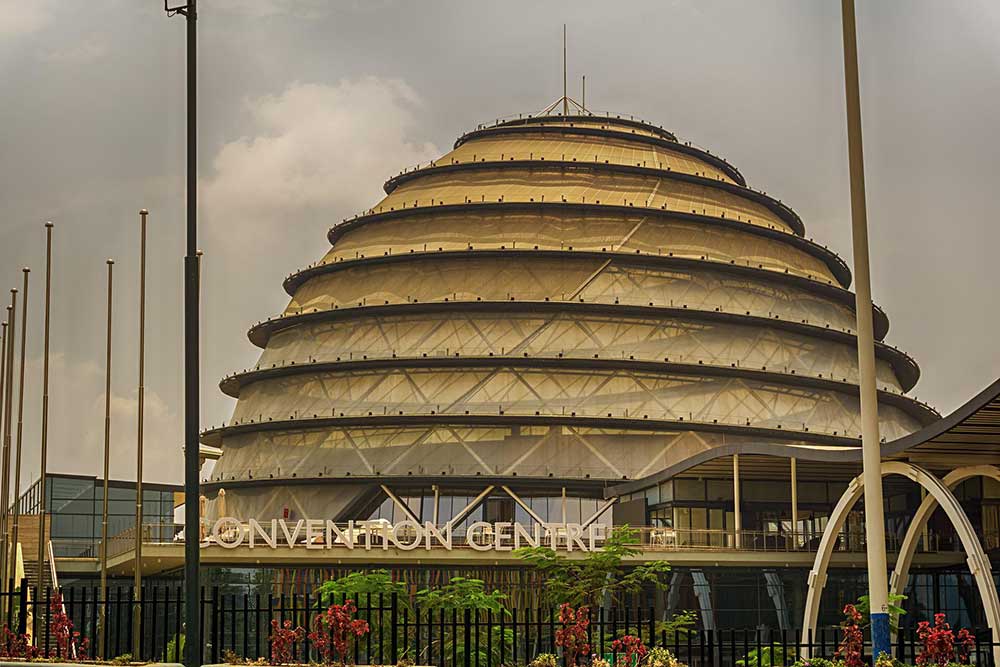
The Kigali Convention Centre (KCC) has a net floor area of 32,200 square meters with 18 different meeting spaces all equipped with AV. Its facilities cater to all types of events and can accommodate up to 5,000 delegates. Adjacent to the KCC is the Radisson Blu Hotel & Convention Centre, which also has an auditorium that can hold up to 2,600 guests. Other well-known properties include the Kigali Marriott Hotel with 254 rooms and the Kigali Serena which offers a 500-seat auditorium and fully equipped ballroom.
Outside the city, the country offers a wide range of boutique hotels and lodges from rustic to luxurious with architecture and interiors rooted in Rwandan cultural traditions. Some even provide meeting spaces that can accommodate mid-size groups. Bisate, Virunga and Kwitonda lodges offer suites and dramatic views of the peaks of the Volcanoes National Park. Whereas One & Only Nyungwe House’s luxury accommodations sit among the tea plantations on the edge of the Nyungwe National Park.
Food or entertainment
Music and dance are an integral part of Rwandan culture, particularly drums, and traditional arts and crafts are produced throughout the country. Some of the world’s best tea and coffee is grown in Rwanda. The high mountains, cool climate and rich volcanic soil result in their top-quality products. Visitors can explore the growing and production process from nursery to plantation, pruning, picking, washing, drying and the many steps to finally get to roasting (in the case of coffee). Their experience can be completed with a memorable tea or coffee tasting experience.
An incentive like no other
It takes a mere 2.5-hour drive or 20 minute flight from Kigali to enter the Volcanoes National Park where the majestic landscape will draw you in with the misty air, which creates a sense of mystery. One-third of the world’s remaining mountain gorillas live in the park, along with many other species, including golden monkeys.
Seeing mountain gorillas in the wild is a profound experience. Expert trackers and guides lead travelers to fully habituated, yet wild, mountain gorillas. Visitors can crouch just a few feet away and the sense of connection between species is real. The encounter is not only physical but emotional. They know you are watching and both groups perceive familiarity and behavioral clues.

Gorillas are not the only primates found in Rwanda. The Nyungwe National Park is home to colobus monkeys, chimpanzees, owl-faced monkeys and l’Hoest monkeys. Primate treks are led by well-trained guides through the park’s forest.
Furthermore, incredible cultural and historical sites are found to the south, such as in Nyanza, as well as breathtaking landscapes from Rubavu and Lake Kivu in the north. Accommodations throughout the country are as varied and spectacular as its surroundings.
-

3 meetings and events trends we haven’t seen the last of
The past year has given us countless trends and cultural shifts in the way we work, travel, and meet colleagues and clients. From the rise of buzzword terms like quiet quitting to rising costs and speculation over the permanence of virtual meetings and what jobs AI would render non-existent, 2022 felt exciting and ominous.
While inflation and continued labor challenges across the travel and events sector leaves some trepidation, there’s cause for optimism.
Here are a few trends that are likely to stay top of the agenda and evolve in 2023.
High demand
By midway through 2022, face-to-face meetings and events rebounded sharply — 65% more versus mid 2021 — whilst virtual event volumes scaled back by 70% in the same timeframe.
“The rebound illustrates the enduring value of in-person interaction to companies looking to rebuild culture and attract and retain staff,” Beau Ballin, CWT Meetings & Events’ Global Head Market Development told Skift Meetings, “To get the best value from long-awaited meetings and events and mitigate against rising costs, corporations will need to plan further in advance, budget carefully, and adopt a disciplined approach to managing meetings and events across the organization.”
Greener meetings and events
If there’s one trend we can look forward to continuing in the new year, it’s the appetite for weaving sustainability into event planning.
“We have seen sustainability questions in RFPs for years, however often the individual meeting owner does not seem as engaged and the budget can get in the way. Start small, and build upon your strategy.“ says Katherine Bell, CWT Meetings & Events’ Director Global Process and Implementation in 6 steps to achieve more sustainable meetings & events, “Decide what carbon emissions you want to measure and do that consistently across your program of events so you have a baseline you can then improve upon. Metrics for measurement vary greatly globally and the industry lacks standardization in this area. This is gradually getting easier with more accessible emissions calculators which is good, but then challenge what you are going to do with the output.” Bell recommends sharing ‘visual guilt’ with attendees rather than just a number of tons of CO2 as this will be more meaningful and generate positive action. Publicize what projects have been supported through offsetting measures.
Adapting to virtual attendance
“During the early days of the pandemic many technology decisions were rushed,” says Fredrik Hermelin, CWT Meetings & Events Snr Director Global Sales, “This led to companies buying pricey subscriptions to virtual platforms to organize virtual events that they tried to manage themselves. The experience was poor, expensive and issues with cameras, firewalls and sound created frustration. This negative experience hid the alternative to traditional meetings that this technology presented.”
Today 30-40% of clients include virtual technology in their programs, either as part of their business continuity plans, as a back-up for important events, or as a natural step in their evolution towards a more sustainable M&E program. Those allowing for professional support find the experience infinitely smoother and companies are increasingly savvy about engaging virtual attendees via polls and quizzes, tech support, gamification and event moderation designed for virtual attendance.
The world has yet to fully recover economically from the impact of the pandemic, and geopolitical upheaval. While there are unknowns ahead, we can look forward to another year of growth, of leaps and bounds in technology, and measuring and managing travel and events more sustainably for live and virtual attendees alike. Here’s to sowing the seeds of innovation, creativity and progress in 2023, together.
Image credits: Adobe Stock
-

The future of events – From new normal to new natural
Before I started writing, I was talking to a colleague based in London. Every time we talk, the scene follows a similar pattern; I digitally call her, and she opens her computer and welcomes me to her home with a big smile. She knows more about me and my family than many people here in Stockholm. When we speak, we open our cameras and we go about the projects we are working on together, and inevitably share our domestic lives in the process. Despite the fact that we only meet two or three times a year, we’ve developed a strong bond and working relationship that feels so natural.
Like us, many people have moved from the new normal, a popular catch phrase coined during the pandemic, to the new natural. Our working styles and the way we meet have changed forever.
A new way to meet
At CWT our meetings and events attendees are going through the same changes that we are, so we as meeting planners must adapt. This new natural involves virtual and hybrid events. Sometimes we will be in person and sometimes we will meet digitally. The difference is that today, attendees can decide on their own agenda and act accordingly. Sometimes it will make sense for them to attend in person and to join virtually on other occasions.
It’s becoming very important for organizers to make sure they have a very clear agenda, show the value of a meeting, and make sure to invite the right people. They must also create an environment that allows all attendees to collaborate and engage, regardless of if they are joining in person or connecting virtually.
Virtual or in-person, an attendee choice
During the early days of the pandemic (March, April 2020) many technology decisions were rushed. This led to many companies buying expensive subscriptions for virtual platforms to organize virtual events that they tried to manage themselves. Lead times grew longer as frustrations grew higher. The experience was poor, expensive and issues with cameras, firewalls and sound created frustration. This negative experience hid the great alternative to traditional meetings that this technology presented.
In comparison, for those who allowed professional support along the way, the transformation into using virtual technology was a lot smoother. Today about 30-40% of our clients include virtual technology in their programs, either as part of their business continuity plans, as a back-up for important events’ or as a natural step in their evolution towards a more sustainable M&E program.
The meeting planner of the future
The CWT meeting planners are famous for their logistics expertise and ability to multitask. With the arrival of virtual events, they had to adapt, and their skillsets expanded. First, we needed to understand the differences between the traditional in-person meeting planning and virtual planning. Next, they learned how to combine them in hybrid planning.
We all agree that content is the most important part of an event, but when the channel switches from F2F to hybrid or virtual, things need to adjust. Understanding how to engage different audiences is a good starting point: which narratives to use, the pace and timing and which data to look for. So, there is a need for a new breed of planners; planners that are comfortable with technology, broadcasting, and audiovisual production companies. They need the same multitasking skills, but also bravery when it comes to switchboards and cameras. Finally, they need to be able to guide speakers and participants through a new environment that may be unfamiliar to clients and attendees alike.
Use technology to mitigate risks
Using technology and building a platform to collaborate gives us a great alternative to mitigate the risk of travelling in sensitive times e.g., around big holidays, during Industrial actions, or to destinations with a higher risk profile.
This technology also gives us a chance to make sure that whatever happens, we can still execute the meeting with the right audience, speakers, sponsors or/and stakeholders from any location in the world.Data – The Great Value
Data is instrumental to measure the ROI (Return on Investment) for every meeting or event. This is something many clients have difficulties capturing or simply do not think of collecting. But if you want to measure your ROI, then the data and attendee experience is crucial.
We often explain to our clients around the world how we collect and analyze data and how it measures ROI. The first step is to set a clear event objective, and find the environment, location and venue that will support this objective. The next step is to invite the right audience who will bring value, contributions and benefit from the meeting or event. Lastly and most importantly, you need to establish how to measure the outcome, which is often done by surveys.With virtual technology, we can plan and engage data points to each step of the project.
Invitations, registrations, logins, clicks, downloads, interactions, comments or time spent on certain topics. All this data can and must be planned for collection before the event to gain the best results. Without forgetting, of course, asking for the necessary permissions to be GDPR compliant if the data will be used further for marketing or communications campaigns.For us, it is just natural
I paused this blog for a short business trip to London. I met my colleague in person. We walked through the London streets talking about work and life. The best way to describe it is like having many of those “coffee machine encounters” condensed into one afternoon. For some, it may feel weird, for us, it is just natural.
Read more about organizing virtual and hybrid events
Image credits: Adobe Stock
-

2022: A year in review
To simply call 2022 eventful would be an understatement. From geopolitical conflicts and the resulting economic consequences to the passing of one of the longest serving monarchs in history, from Twitter takeovers to slaps and historic world cup wins, this year certainly hasn’t been short on stories.
And as CWT celebrated 150 years in travel, we not only reflected on how far both we and wider travel industry have come, but also looked forward to the future. We are excited to shape and enable the future of travel, a future that will require continued innovation. As the world opened up after the pandemic, CWT rolled out rail and air booking capabilities along with other enhancements to our myCWT platform. We also teamed up with several companies with innovative and market-leading solutions to help bring additional value to our customers (Wenrix, ZYTLYN, Thrust Carbon). Furthermore 2022 was the year CWT strengthened its finance and strategy leadership teams and celebrated the return of the live award show for the Business Travel Journalism Awards (BTJAs).
In 2022 we published over 100 blogposts exploring many aspects of the travel and meetings industry, including challenges, evolutions in tech and the future trends we have to look forward to. Some of the most prevalent themes included:
The path to more Sustainable travel
- Target Practice: 3 ways to achieve your company’s sustainability targets
- Fast change in a slow environment: 4 things you can do now to accelerate toward ‘net zero’
- How to meet demand for greener travel
- 3 easy ways to become a more eco-conscious traveler
Travel bouncing back
- Top tips for corporate travelers as business trips ramps up at pace
- The Bounce Back: Evolving travel management for a new era
- Return to Travel Roundup: A step-by-step roundtrip checklist
Wellbeing of travelers
- Taking the strain out of travel: 12 thoughts on traveler wellbeing
- Understanding the behavior of the digital traveler
- 10 jet lag myths debunked
Looking to 2023, the good news is that travel is picking up again to pre-pandemic levels, but as CWT and GBTA’s 2023 Global Travel Forecast predicts, “the outlook for the industry is positive, though there are potential risks that could frustrate recovery.” Travel buyers will continue to navigate rising airfares and hotel rates as global inflation pressures continue. Attaining and justifying trip return on investment will be top of travel manager’s agendas, with the added expectation within every corporate travel program and RFP to steadily and meaningfully minimize the environmental impact of business travel.
Next year our blog page will be packed again with the very latest concerning all things business travel and meetings and events, including industry insights, interviews with industry experts, and much more. So, don’t forget to keep checking our blog page and social media channels.
For now CWT wishes everybody a healthy, happy and successful 2023. See you soon!
Image credits: Adobe Stock
-

Positive Travel Trends on the horizon for 2023
It’s safe to say that the news about travel (and the world in general) hasn’t been too cheerful over the last few months. Between economic concerns and travel disruptions, you’d be forgiven for having an outlook that was glass half empty for the new year. Luckily, it isn’t all doom in gloom for the business travel industry. After a strong recovery in 2022, there is plenty to look forward to in the new year!
Here are 3 positive business travel trends from our industry experts:
Belinda Hindmarsh – EVP & Chief Growth Officer
Sustainability will become an even bigger focus for many enterprises in 2023. We recently surveyed many of our clients, and two thirds told us that sustainability has become more important after the pandemic. One of the first hurdles to clear is setting goals and finding a path to achieving them – a journey that we are taking many of our large enterprise clients on.
Although change does start at the top, we all have a part to play. Therefore, we are using analytics tools to provide more information at the booking stage. With the help of meaningful data, travelers can see, for example, the emissions that will be produced on a given trip. This visibility will help travelers to make more informed decisions and contribute to their company’s sustainability goals.
Joel Hanson – Sr. Director, Innovation Business Development CWT
With 2023 on the horizon, our industry has countless reasons to feel positive, not least of which is the simple fact that once again we are enabling human connection in full, vivid, 3D Technicolor. I have noticed that face to face contains at least 100x more data than any web conferencing tool – there are few substitutes for body language and facial cues, and I see face to face as the ultimate premium technology moving forward.
That said, the business travel industry can enter 2023 feeling positive not just about re-connecting the world, but increasingly, about how we are doing so. We are standing in the foothills of a new era, characterized by a shift to conscious business travel. To me, conscious business travel is a mega-trend for 2023 and beyond, and emerging signs of this megatrend abound.
Ian Cummings – Global Head CWT Meetings & Events
Despite some economic uncertainty & geopolitical turmoil at an all-time high, the Meetings & Events industry is better prepared to weather any storm than ever before. The use of the technology available will allow our industry to continue to thrive, whether it be face-to-face, with virtual events or the combination of the two. This allows us to adjust for cost controls, deal with rapid and sudden change, and facilitate vital corporate communications.
Retreats and incentives are higher up the priority lists for many corporates. We have seen a 65% increase in live face-to-face meetings, including incentives, over the last 12 months. Time being a precious commodity is not something new, but the very fierce focus on how we spend our time has never been more important. Enabling teams to be together, in calm spaces where attendees can focus, think, innovate, and create, away from the hustle and bustle of big cities has seen the emergence of new brands. Even within the big brand’s portfolios, lifestyle retreats focused on wellness, sustainability, from farm to table eating and building agendas that include time to relax are becoming more popular.
And finally, if the last 2.5 years have taught us anything – it’s the power of face to face is irreplaceable. And with flexible working being the new norm, corporates will have to work harder to bring teams together again and invest in those all-important human connections
-

Exit an airport in record time – 8 helpful tips
Ian Cummings, Global Head CWT Meetings & Events shares his insights on getting on and off planes and in/out of the airport as fast as possible:
As a London based global business traveler, I would like to think I am a master at getting through airports quickly, just as everyone. Like most of my experienced travel peers, the pre-boarding process is not something I ever look forward to, and it is my mission to minimize the agro. Especially after a long business trip, I want to get back home as quickly as possible, with minimal fuss. Especially with two young children, getting back home before bedtime is a high priority.
Want to know how I do it? Here are my top tips:
1. Stay calm
Minimize stress and allow plenty of time; gates close earlier than ever before so check the time to get from shopping hall to gate. Check-in online, download your boarding pass to your phone and opt for the priority security queue and boarding if available. Keep conversations to a minimum, grab a coffee or a healthy snack at one of the eateries within the airport.
2. Travel light
It enables you to overtake other passengers when heading to passport control. When you reach, use the electronic gates if you have an ePassport or local ID.
3. Always try for hand baggage only
Whether it is on wheels or a shoulder strap computer bag with space for the essentials. It helps not having to wait for checked luggage to be released. If you’re travelling with colleagues who want to check in luggage – be clear you aren’t waiting for them!
4. Position yourself near the bus doors
Although you’ve positioned yourself towards the front of the plane – the dreaded remote stand can be the downfall! If your plane docks at a remote stand, position yourself near the bus doors, enabling you to be the first off and into the passport queue at the front.
5. Take advantage of annual memberships
If flying with EasyJet, take advantage of their “EasyJet plus club,” it costs the same as one flight for an annual membership, which you can recover back on one flight change, plus you benefit from boarding priority.
6. Be eco conscious – consider using public transport
Most European and Asian airports are well serviced by high-speed trains such as Amsterdam, Stockholm and Barcelona. It’s more environmentally friendly and often much faster than a taxi – especially as you arrive in the city. Once in the city – consider moving around on e-scooters or e-bikes such as Lime or Human Forrest.
7. Use transport apps to plan your journey home
If you must use vehicles to and from home / airports. plan your journey carefully using transport apps with pre-bookings, such as Uber, Lyft, Free Now, Get Cab or Trainline depending on your destination. No tickets required – tap in and out. In Paris I use Moto-Taxi motorbikes during rush hour for to/from Gare du Nord.
8. Set your stopwatch
Play it like a game. Set your stopwatch from the second you step off the plane until you exit the airport – most of it is in your control. Record your best times and see if you can beat it.
And one additional sub note – due to passport control queues for Brits in EU, post BREXIT – consider obtaining an EU passport if you can, to facilitate more speedy cross border movements within EU queue channels!
As I am based in southwest London, I only ever use Heathrow or Gatwick airports. I am proud to say I frequently make it out of both airports in less than 10 minutes from stepping off the plane to exiting; My personal best has been at Gatwick, managing “plane to train” in seven minutes. The only downside of it all is my wife hates traveling with me.
Image credits: Adobe Stock
-

And that’s a wrap: 5 ways that business travelers can prepare for 2023
As the new year approaches, the heavy-duty work of 2023 budgeting, strategizing and business planning behind us and 365 days of new opportunities laid out ahead, it’s important for business travelers to be prepared for the challenges and opportunities that lie ahead. Here are 5 ways that business travelers can prepare for the new year.
- Review your travel policies and procedures. Take a moment to review your organization’s travel policies and procedures to ensure that you are up to date on the latest guidelines and requirements. This can help you avoid any unexpected issues or delays when you are next on the road.
- Update your travel documents. Make sure that your passport, visas and other travel documents are up to date and in order. This can help you avoid any delays or issues when you are traveling internationally.
- Upgrade and streamline. With emails slowing to a trickle as the new year approaches you might find yourself with a little more time available than usual to browse the web. Research the latest in travel gadgets, packing cubes, travel apps and multi-purpose clothing to make next year’s trips smoother.
- Replenish your reserves. Business travel can be stressful and can take a toll on your health. Be sure to take advantage of this quieter time to take care of yourself by getting plenty of rest, and filling your cup with the things that make you happy such as spending time with family and friends, going for long walks and the creative pursuits you haven’t had much time for recently.
- Get organized. Prepare for the new year by decluttering your files, getting your travel documents and itineraries organized and easily accessible, and researching fun things to do on your next trip or with family and friends between business trips. Planning fun events ahead of time can help boost optimism for a busy working year.
By following these tips, business travelers can start the year on the right foot and be prepared for whatever the future holds.