
Introducing the latest myCWT product and service enhancements
Building on our digital, omnichannel myCWT platform, our new products and services will simplify travel management for you and your employees – anytime, anywhere, anyhow.
Note: Featured services may not be available in your country at this time. Please reach out to your CWT representative for more details.
Hear from Chief Product Officer, Erica Antony as she shares the key product highlights of 2024, along with the key areas driving innovation.
-
2040: Baseline, Boom or Bust
As we enter an era of rapid transformation and unprecedented challenges, it is essential for travel managers, meeting & event planners, and corporate decision-makers to look ahead and frame our current strategic thinking with a clear vision of the future. Business travel and meetings and events (M&E) are poised for significant change over the next decade and a half, driven by a complex interplay of sustainability goals, technological advancements, evolving work models, and geopolitical dynamics.
In this paper to mark the 10th anniversary of our Global Business Travel Forecast, we explore, for the first time, a long-term vision of the future and potential trajectories through three distinct scenarios, each offering insights into how these forces should affect policy-making, budgeting and priorities. By examining these scenarios, we can better understand the diverse possibilities that lie ahead and the strategic imperatives required to thrive in each potential future.
Based on trajectory data analysis and interviews with industry leaders, behaviorists and climate tech founders, this forward-looking approach enables us to anticipate changes, strengthen our strategies, and make informed decisions that align long-term objectives. It is through this lens of foresight and adaptability that we can build resilience, seize opportunities, and navigate the complexities of the future.
We invite you to reflect on the insights presented, and consider how your organization can prepare for the opportunities and challenges that lie ahead. Together we can ensure that travel and meetings remain catalysts for growth, scalability and sustainable practices.
- Scenario development is both an art and a science
- Megatrends Shaping the Future of Business Travel, Meetings and Events
- Sustainability goals the new crux of corporate policy
- Technology Revolutionizes Travel Management
- Modern work models spark new travel patterns
- Changing demographics open doors to new opportunities
- Three Scenarios: Base case, boom and bust
- Future-proofing strategies

-

CWT GBTA Global business travel forecast 2025
When it comes to pricing, global business travel has finally reached an enduring, higher baseline. Prices will continue to rise in 2025, but only moderately, so expect a period of normalized growth.
However, this pricing environment, one of marginal gains and price regularity, is fragile. Global leisure travel has now realized a lot of its pent-up demand, while corporate travel has been resurgent, with 2024 edging at preCovid levels.
There are many factors at play, whether its volatile oil prices, labor costs and constraints, inflationary pressures, and geopolitical factors. As this elevated baseline edges upwards, albeit marginally, travel budgets will come under increased scrutiny, especially as travel patterns and attitudes change.
It’s why business travel can’t be viewed in a silo, and the true value to an organization must be fully realized. This forecast can help with those calculations.
-

Capitalize on emerging technologies in corporate travel
Technological advancements are accelerating at an unprecedented pace. How will emerging innovations like Generative AI, blockchain, and self-sovereign identity (SSI) transform corporate travel?
BTN and CWT probed global CEOs, travel managers, industry consultants and tech experts on the promises, questions, and expectations these innovations raise and how they are set to reshape traveler experience, cost control and service delivery in corporate travel and events.
Download and discover
- The technologies that will have the greatest impact on corporate travel in the next 2-5 years
- How these emerging technologies are poised to control costs, enhance service and security, and boost efficiency
- The critical challenges, opportunities, risks and roadblocks each innovation raises
- What travel managers, buyers and experts anticipate from these innovations
-
Richard Saunders appointed Vice President of CWT’s Global Partners Network
CWT, the Business-to-Business-for-Employees (B2B4E) travel management platform, today announces the appointment of Richard Saunders as Vice President, Global Partners Network (GPN), with immediate effect.
Reporting to Vince Chirico, Senior Vice President, Global Supply Chain Partners, Richard was formerly co-lead of the team, having previously also managed GPN’s commercial operations.
“Richard’s wealth of experience and expertise uniquely position him to continue the development of the network,” said Vince Chirico. “At the same time, Richard will continue to support CWT and our customers’ business needs as we expand our product and technology footprint into more of the Global Partner Network.”
Prior to joining CWT in 2007, where he originally worked in the client organisation supporting major corporate and government customers, Richard spent six years with United Airlines, where he managed offline sales and alliance activities in the Middle East & Africa, as well as looking after the two largest TMC customers for United in the UK. Before joining United Airlines, he held a variety of operational and commercial roles with American Express.
CWT is a leading global partner in business travel, meetings, and events. Operating across six continents, we deliver sustainable, tailored solutions that help organizations connect, engage, and thrive in an evolving world. Our myCWT platform integrates advanced technology with human expertise to simplify travel and enhance traveler and attendee experiences. Extensive global coverage, seamless data integration, AI-driven analytics, and carbon-conscious travel tools enable businesses to optimize their travel and meetings programs while delivering measurable value.
With 150 years of industry experience and a deep commitment to partnership, CWT collaborates with clients to shape the future of business travel and events, making them more efficient, responsible, and impactful.
CWT works with nearly 100 partner agencies around the world to support its customers in markets where it doesn’t have owned operations. CWT’s Global Partners Network (GPN) team creates a best-in-class and consistent customer experience across all our partner markets. This includes making CWT’s core tools, products and services available universally; investing in new and innovative solutions; and ensuring all our partners comply with CWT’s standards with respect to our core values, code of conduct, ethics, responsible business and data privacy.
-

Relaxed testing and quarantine requirements reveal pent-up demand for business travel
CWT, the business-to-business-for-employees (B2B4E) travel management platform, has observed a significant increase in travel to and from several countries that have recently relaxed testing and quarantine requirements for international travel.
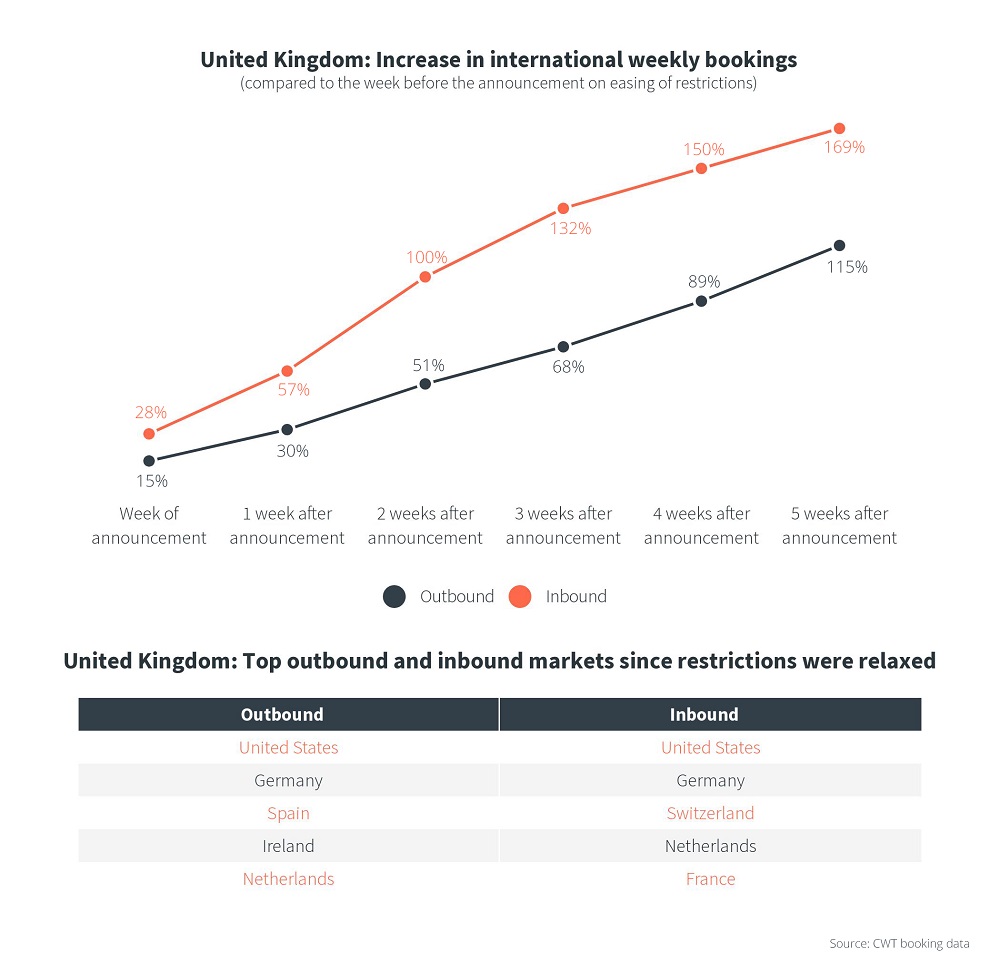
In the United Kingdom (UK), CWT booking data shows weekly bookings for outbound international travel have increased 115% since the country announced on 24 January that it would scrap testing for fully vaccinated travelers from 11 February. Inbound bookings have soared 169% compared to the week before the announcement.
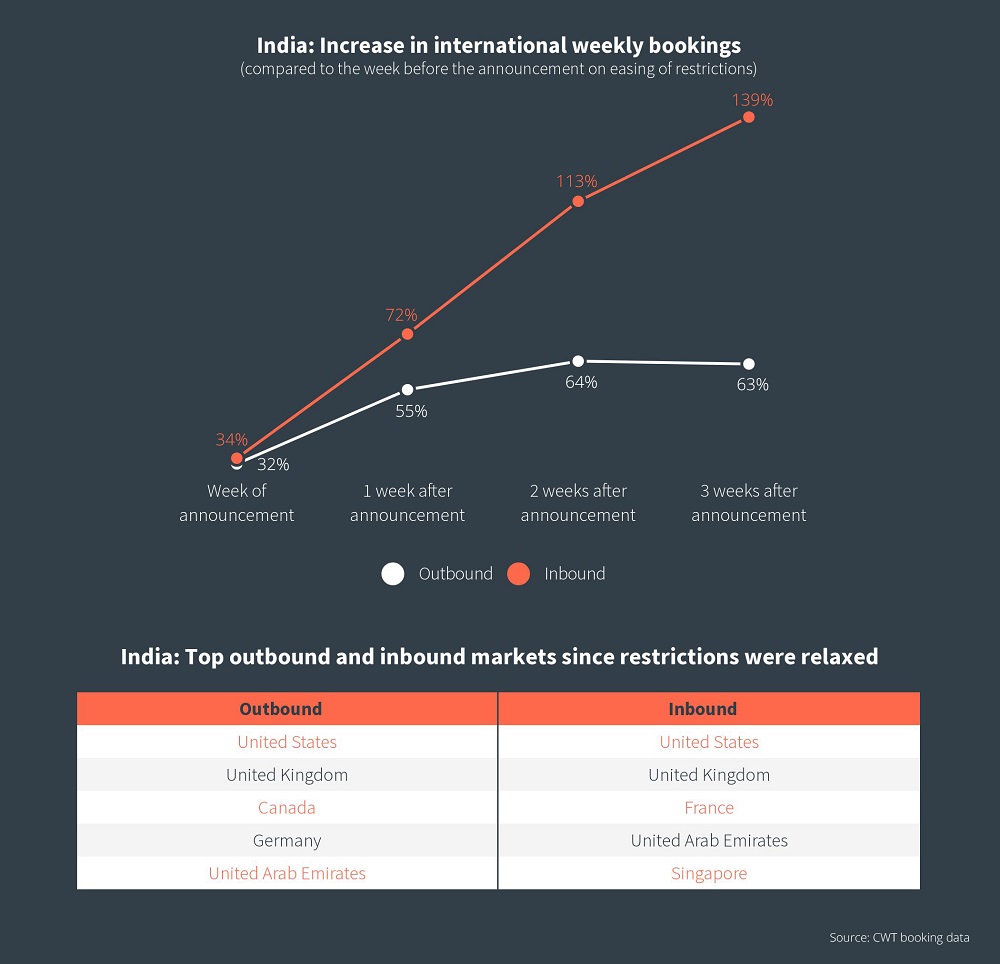
It’s a similar story in India where outbound bookings climbed 64%, while inbound bookings are up 139%, following the announcement on 10 February that vaccinated travelers from 82 countries would no longer need to show a negative test result or isolate starting 14 February.
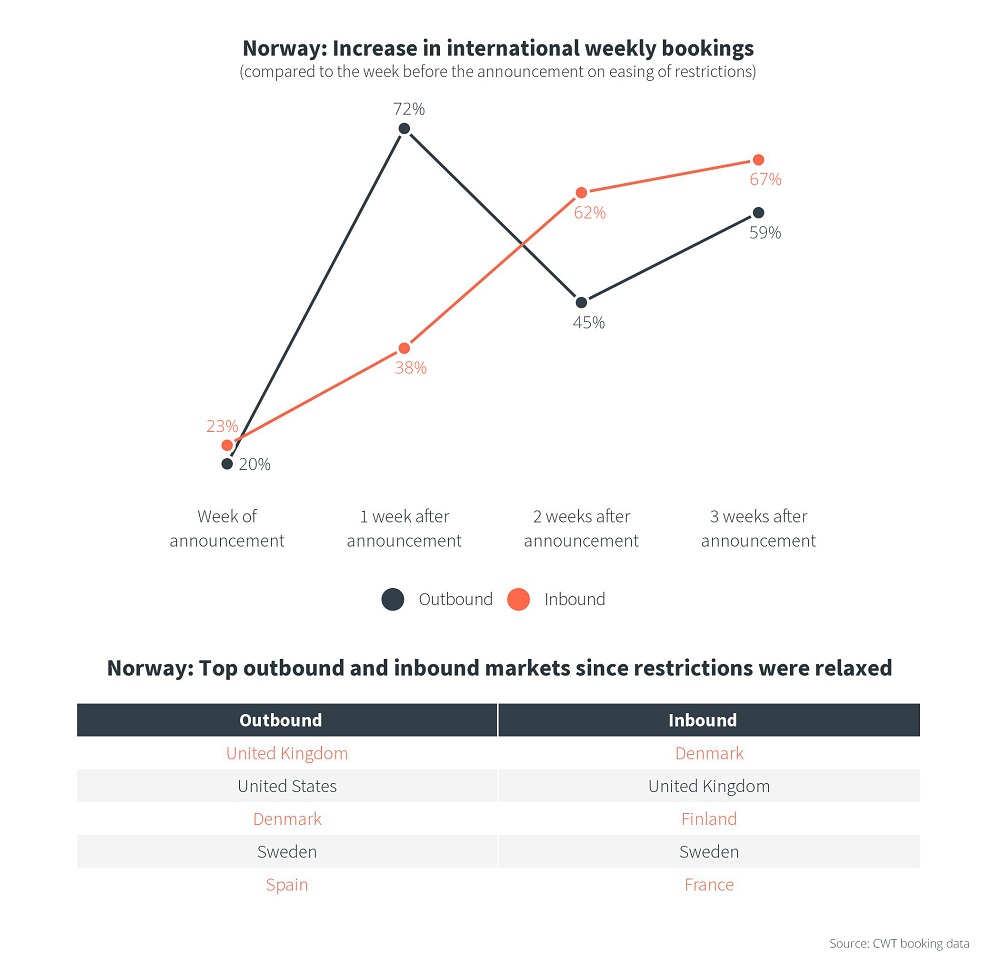
In Norway, which went a step further and put an end to testing for all travelers — including those who are unvaccinated — with immediate effect on 12 February, weekly outbound and inbound bookings have risen as much as 72% and 67%, respectively.
“The strength of pent-up demand for business travel is clear,” said CWT’s CEO, Michelle McKinney Frymire. “We are seeing the highest levels of business travel since the pandemic began and, while traveler health and safety must always remain the number one priority, removing hurdles and uncertainty will be key in achieving a full recovery. This, in turn, will help stimulate economic growth, and it is encouraging to see the potential benefits arising from some countries relaxing these restrictions. We continue to make major investments in our innovative platform and services to create an unbeatable experience for companies and their travelers, so we’re eager to help more people reconnect in-person with their colleagues and business partners this year.”
CWT is a leading global partner in business travel, meetings, and events. Operating across six continents, we deliver sustainable, tailored solutions that help organizations connect, engage, and thrive in an evolving world. Our myCWT platform integrates advanced technology with human expertise to simplify travel and enhance traveler and attendee experiences. Extensive global coverage, seamless data integration, AI-driven analytics, and carbon-conscious travel tools enable businesses to optimize their travel and meetings programs while delivering measurable value.
With 150 years of industry experience and a deep commitment to partnership, CWT collaborates with clients to shape the future of business travel and events, making them more efficient, responsible, and impactful.
-

Power moves: 3 ways to be an ally to women at work
When it comes to gender equality, we’ve seen a lot of progress in a very short time.
In 1970 a woman in the U.S couldn’t take out a credit card in her own name or serve on a jury. A multi-national company like CWT with 50/50 male and female leadership and a female CEO was unheard of. Of course, progress varies dramatically by country.
Organizational and policy advancements are integral to progress but women are still struggling on the battleground of everyday sexism.
In our latest podcast episode, How to make work (and traveling for work) work for women, Chief Technology Officer John Pelant, one of three leaders of CWT’s women’s employee resource group talks about practical ways to be an ally.
Research has shown that in the absence of male support, women shoulder the burden of day-to-day sexism alone. Highlighting the strengths of female colleagues, listening to their stories, or being helpful while traveling together counters the effects of sexism and contributes to happy, high-functioning teams all round. Here are 3 ways to be a better ally to women.
Caring curiosity wins every time
Regardless of race or gender, everybody’s lived experience is different. A spirit of caring curiosity is always welcome, and speaking from experience can eliminate generalizations.
A 2019 study by SAP Concur found that 3 in 4 female business travelers have suffered harassment while traveling and more than half changed their plans because of safety concerns.
Listening to a female colleague can help you to help her. You might ask her how she feels walking back to her hotel from dinner. She might respond, “It’s scary to walk back alone every night because that group of guys on the corner keep harassing me.” You could then offer to walk back with her.
Acknowledge your colleagues
Certain demographics may find their expertise and ambition questioned more than others. Make it a point to acknowledge different skills and solicit opinions.
In one study cited by Ted.com, nearly two-thirds of women and people of color in engineering reported needing to demonstrate their expertise repeatedly, compared to 35 percent of white men. They found that their achievements were discounted, and they were pressured to let white men take credit, while at the same time they were asked to do office tasks.
Nip patronizing explanations in the bud
Every woman who has ever lived has been educated about a topic she knows more about than the person speaking to her. Bonus points if you’re on the young side, a bit old, a new starter, not white, have a PhD in – or ten plus years experience – in the subject at hand.
It can be frustrating when a speaker assumes you know less because of your gender or worse, interrupts you.
“In meetings, when a man interrupts a woman, I stay quiet,” says Andrew who works for a global NGO, “When he is done, I don’t respond but turn back to my female colleague and say something like ’Sorry Padma, what were you saying?’ to the woman.”
If you bring the conversation back to the woman, they may think twice about doing it to another woman again.
Hear more about being an ally in our latest podcast episode.
Image credits: Adobe Stock
-
Maximizing the value of combined travel and meetings & events programs
We’ve seen all too recently the devastating impact of world events and the effect they have on people and their movement. Whether the crises are a result of a global pandemic, natural disaster or a political conflict, organizations have a duty of care to know where their employees are to be able to support them in any kind of force majeure situation. Add to that today’s model of hybrid and remote working and it raises profound questions about an organization’s approach to employee travel, when and where to bring people together – and why it should be done in the first place.
But aside from the obvious wellbeing and duty of care practicalities, there are other benefits to maximizing the value of integrated travel, meetings and events programs. According to Cirium, business travel is expected to accelerate in 2022 driven by an increase in meetings & events, with companies already having increased their business travel spend.
Why combine travel with meetings & events?
Professional development
Combining business travel with meetings & events is an opportunity for those managing travel programs to move into broader, more strategic roles as employee collaboration or mobility managers. In addition to benefiting the organization, the influence of the travel function and its team expands.
Strategic sourcing
Joint sourcing is one super-strategic benefit. By combining your travel and meetings & events program, you will get more transparency into total spend from both areas, not to mention enhanced supplier negotiations and risk mitigation, driving adoption and compliance.
In addition, consolidating with one supplier to manage both delivers better policy control, helps to optimize your supplier deals and simultaneously provides the ability to track travelers. In conjunction with this, it is our experience that thoughtful and well-communicated policies, that embrace all areas of travel, can support travelers’ engagement, wellbeing and employee retention.
Defining program inclusion
Though there are many advantages, there are also stark contrasts. Travel is often to attend meetings, but not necessarily events. Events aren’t always for employees. Why do we differentiate? A meeting may be internally at another office, or it may be with one or two customers at their office locations, but any way you look at it, it’s all Travel & Expense spend that the organization needs to optimize.
If we rewind two years, organizations saw their travel program as a fait-accompli or deemed meetings & events as ‘just too complicated’ to even attempt to tackle. In most instances they simply had too much already on their plates to even try to take an additional category under their wing. The pause in travel resulting from the pandemic may have caused a re-think, but also provided the breathing space to do it.
Even before Covid, we had seen a trend towards Travel Managers and Procurement starting to look at meetings & events in more detail, some with a view to gaining visibility, others having to report cost and spend to leadership, or to meet duty of care obligations. We’ve also seen the merging of mature meetings and travel programs, as innovative leaders from both areas have sought further improvements – together going beyond their historically separate areas of responsibility. Although there are some hurdles to overcome along the way, there are huge potential benefits to program integration. Let’s take a look at some of them now…
More benefits of an integrated approach
- Greater visibility across travel and M&E spend can support supplier negotiations,
- Management reporting captures all spend, not just the transient elements.
- Drives adoption and compliance if managed centrally and continuously communicated.
- Supports travel policy and duty of care:
- Consolidation to one supplier for management of both travel management and meetings & events programs provides policy control, optimizes supplier deals, and simultaneously provides traveler tracking capabilities.
- Virtual and hybrid events are on the rise and should be written into policies moving forwards. Working with a supplier that understand both worlds removes complexity and boosts ROI.
- Increased use of virtual and hybrid events also reduces carbon footprint, contributing to sustainability goals which are now front and center for an increasing number of organizations.
- Use of small meetings tools like CWT easy meetings bridges the gap that historically has been very hard to capture and manage, offering an easy-to-use option for meeting planners.
- Reducing the number of suppliers across travel and meetings & events offers opportunities to save and negotiate via a strategic approach. The ‘triangle’ between the customer, travel management and meetings & events company and other partners drives innovation and efficiencies across an integrated program.
- Improved meetings & events analytics, spend data capture and ultimately ROI
- Consistent service delivery across the entire integrated program, from specialist teams in both transient travel and meetings & events.
- A carefully considered and communicated policy covering all areas of travel can support employee engagement, staff retention and wellbeing – and become a real differentiator in today’s highly competitive recruitment marketplace.
The challenges to be overcome in taking programs to this next, integrated level include working with a diverse range of stakeholders with interests right across the travel, meetings & events spectrum. So it’s key to effectively engage with these groups from the outset and build successful relationships through timely, targeted communication with different audiences. With careful planning, and targeted communication, the ‘new normal’ for employee travel can reach previously unattainable heights – for travelers, attendees and employers alike.
For more information, visit CWT Meetings & Events
Image credits: Adobe Stock
-

Podcast: International Women’s Day: How to make work (and traveling for work) work for women
Belinda Hindmarsh, Chief Operating Officer of RoomIt by CWT and China, and John Pelant, Chief Technology Officer, CWT are leaders of CWT’s women’s employee resource group.
Drawing on decades of combined experience in travel and tech, along with leading a global multinational operating in over 140 countries, they talk about breaking the bias at a critical turning point including:
- The role of business travel management in progressing equal opportunities.
- How to build an inclusive culture and inspire more women at an individual, organization and industry level.
- The power of intentional listening and being an ally.
- The pitfalls of proximity bias in remote and hybrid working environments.
- Why we’re at a fork in the road for progressing equality.
[buzzsprout episode=’10209321′ player=’true’]
-

At a crossroads: How International Women’s Day 2022 can be a catalyst for change when we need it most
The era-defining changes that have occurred over the course of a global pandemic will define the future of equality for women who have been disproportionately affected. A 2021 study of Women in the Workplace revealed that three major groups have experienced some of the biggest challenges: working mothers, women in senior management positions, and black women.
Women make up 39 percent of global employment but account for 54 percent of overall job losses due in large part to the increased burden of unpaid care.
Yet the value of women in leadership is undisputed. Companies like CWT who have a female CEO and gender balance in leadership and across a multinational workforce are reported to perform better financially.
Emerging into the future, we have a choice to make. We are capable of regressing decades or ‘breaking the bias’ to benefit everyone. This is the subject of a new podcast episode featuring Belinda Hindmarsh, Chief Operating Officer of RoomIt by CWT and China, and John Pelant, Chief Technology Officer.
Drawing on their leadership of CWT’s women’s employee resource group, decades of combined experience in travel and tech, and leading a global multinational operating in over 140 countries, they talk about:
- The role of business travel management in creating equal opportunities.
- How to build an inclusive culture and inspire more women at an individual, organization and industry level.
- The power of intentional listening and being an ally.
- The pitfalls of proximity bias in remote and hybrid working environments.
Listen to the podcast.
Image credits: Adobe Stock
-

Anticipate, adjust, pivot: Your ultimate guide to managing risk for live events
As we move toward ‘business as usual’ in 2022, live meetings & events may be anything but usual as new norms emerge for insurance coverage, attendee healthcare requirements, financial risk/reward assessment, hybrid options, and more. Meetings and events (M&E) insurance providers have managed countless claims for meetings and events cancelled over the last 20+ months. Now they are fine-tuning policies to clearly exclude a variety of cancellation circumstances while also increasing premiums and deductible thresholds to mitigate future risk and recoup losses from the past two years. Yet, with renewed demand for in-person, face-to-face business interactions, required lead time for M&E and ongoing unpredictability, what steps can be taken to mitigate risk and ensure success?
Know your insurance policy
What was once standard policy coverage may no longer be included and if it is, it may be at an additional premium. Case in point, ‘Force Majeure’ clauses are not likely to include coverage for communicable diseases and other previously common business interruptions. Work with your insurance team to gain an accurate view of both the categories and levels of coverage – included and excluded – before planning a meeting or event.
Incorporate safety protocols
While safety has always been a factor, COVID protocols including social distancing, facemask requirements, proof of vaccination and/or testing, are now routinely expected too. Insurers and/or attendees may require or expect mobile apps, onsite validation, medical expert planning and more, all leading to higher M&E costs.
Weigh the financials
Even if an insurance policy offers some protection against cancellations or reduced attendance, the deductible may be higher than sunk costs, making a claim worthless. Planners must make an informed decision on risks, potential ROI, and how to proceed.
Ready, Set, Pivot!
Virtual and hybrid options assure, at least in part, objectives of a meeting or event are met and are likely here to stay. What M&E components can be presented in a virtual format to deliver key messages, build critical relationships, etc.? Can you pivot reactively or proactively? Proactive planners are including virtual components to hedge their bets for success.
Vet your venue and vendors
From local official shutdown thresholds to venue policies, vendor and supplier service levels and more, consider contract adjustments to protect against unforeseen circumstances. Can you scale back? Delay? Cancel? If not, what’s your recourse? How can you recoup your financial investment? Is there any insurance coverage under the policy of another organization? Whether hosting, sponsoring, exhibiting or attending, what contractual obligations do you have if you back out? And, if you go forward, what is your liability coverage?
Notably, some hotels report that clients are avoiding signing contracts to swerve taking out insurance. This approach forces hotels to put people on joint-options or a ‘first-signed, first served basis’ making it difficult for suppliers who in turn become less inclined to work with corporates who take the no-sign approach
Live meetings and events are coming back and full recovery with greater predictability, less risk and less challenge are on the horizon. In the interim, planners will need to adjust, pivot and anticipate continued change and new norms, looking past surviving to again thriving, embracing industry changes to ensure stakeholder success.
Speak to our team about your next event and let us take the strain out of the planning.
Visit CWT Meetings & Events
-
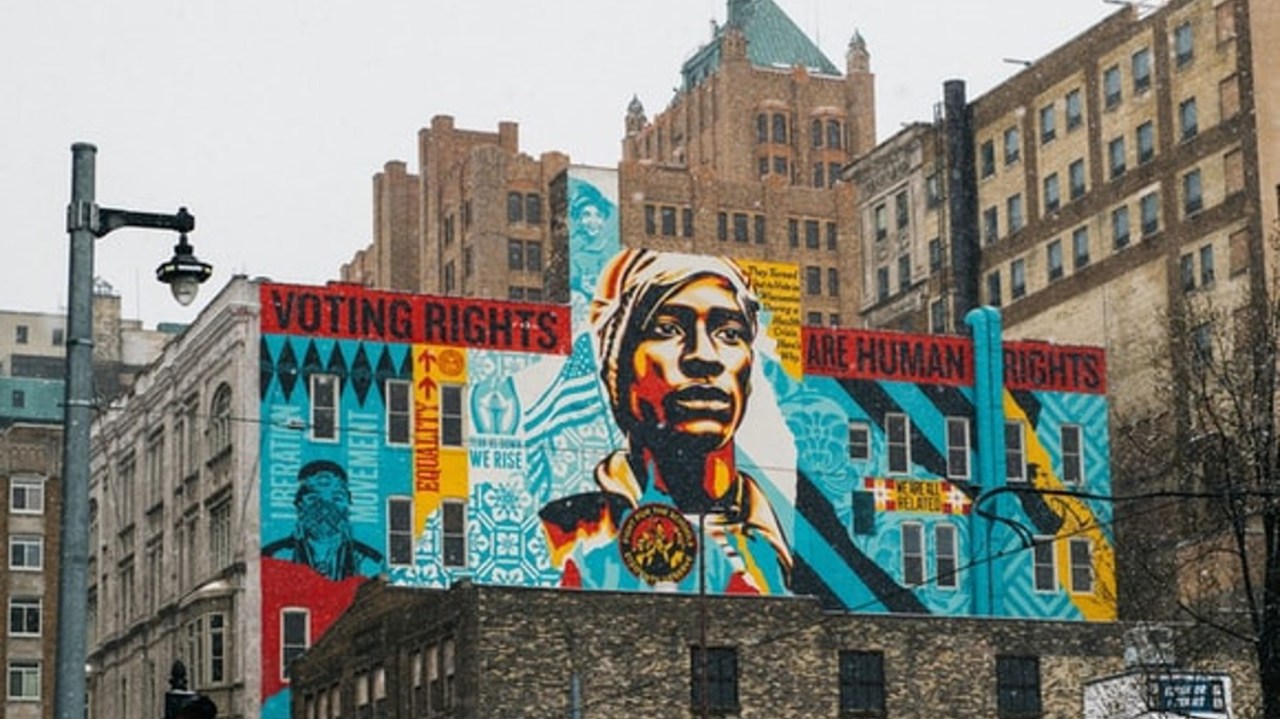
Everyday activism: Mark ‘zero discrimination day’ with these 3 ways to change the world
“Justice is what love looks like in public,” said American philosopher Cornel West.
Today is Zero Discrimination Day, an annual event celebrated on the 1st March, and launched in 2014 to engender people to promote equality before the law and throughout member countries of the UN.
At a time when many are feeling helpless in the face of world events, a day championing inclusion, peace and compassion can feel unachievable.
It can be comforting to remember that changing the world doesn’t occur with a single, grandiose gesture but in how we choose to exist, interact and learn within our communities. It’s in living our values. Here are three ways to show our love for fellow humans through action.
Use social media as a force for good
Some people post a black square to indicate that ‘black lives matter,’ or a rainbow to show support for LGBTQ+ rights. According to Weforum, every minute we collectively send more than 30 million messages on Facebook and over 350,000 tweets. Use your profile to raise funds for a charity, call out disreputable sources or ‘fake news,’ share information and articles designed to educate, and signpost tangible ways others can take action. Be part of the solution, rather than the ‘noise.’
Understand the power of policy
There’s a pervasive myth that success is an entirely individual endeavour, the culmination of ambition and fortitude, no matter the policies that make success improbable for millions. But social mobility is declining. In the UK for instance a government survey found that 79% of adults believe there is a large gap between different social classes.
Get involved in politics to help others have more chances in life. Many people working in public office are driven to make life better. Often they hear from well-funded lobbying groups more than their constituents. Write to your local representatives, attend events and rallies or join a school board, and you can shape policies and futures. Also, vote. Never skip a chance to vote.
Tell and share stories that champion our common humanity
A quote from someone interviewed for Humans of New York reads, “My worldview is this: ‘At all times, people are doing one of two things. They’re showing love. Or they’re crying out for it.’ Stories are powerful because they bolster empathy.
The worst atrocities and discriminatory laws begin with a process of dehumanizing.
Whether you decide to be authentic and vulnerable and share your own experiences or share others’ -especially those of underrepresented backgrounds – you are working towards ‘zero discrimination.’
As we have seen throughout history and are sadly seeing this week, there will be autocrats; people motivated by power and conquest. And there will be those motivated by integrity, caring, connection and curiosity. We are many. And we have more power at our fingertips than ever before.
-

A welcome reception: Is there a growing need for the management of non-employee travel?
Nothing says ‘welcome to the company’ quite like being asked to pay for travel upfront and be reimbursed several months later. Kidding aside, for many years that’s been the status quo for a non-employee of a company, be they a consultant, influential journalist, intern, guest speaker or potential candidate.
Understandably so. Arranging and paying for business travel for non-employees can be an arduous and complicated task requiring manual intervention. Meanwhile, guest travel is only likely to increase as the pandemic has ushered in a renewed focus on types of travel and the question of who truly needs to travel. Additionally, the career landscape is changing in light of what some call ‘the great resignation.’ Freelance and multi-hyphenate careers are increasing, and there’s a growing trend of businesses hiring inspirational speakers, coaches and consultants to help train and retain staff.
CWT identified several years ago that guest travel was an important domain and has been at the forefront of helping shape the space. It’s important for several reasons. First, guest travel is sizable – for many clients, it represents north of 10% of all their transactions. Second, historically it has been rife with process inefficiencies. An HR recruiter wants to focus on getting the right person for the right role, not on the nitty gritty of flights and hotel bookings. Anything that smooths that process for them is welcomed. Third, this type of travel is often critical to a company’s success. First impressions matter. When a company flies a top-notch candidate to headquarters for an interview, it’s vital that the experience be smooth, enjoyable and hassle-free.
Pre-pandemic, we saw that the industry had a pain point around guest travel and then came up with a solution. CWT identified what was then a relatively small but promising start-up as a potential solution for guest services. We worked closely with them, integrating the offering into our infrastructure and bringing the solution to a number of clients in a relatively short period of time. CWT has an established and robust innovation process in concert with our Silicon Valley accelerator Plug and Play, and this was yet another example of being early to a space with forward-looking tech innovation partnerships. When we piloted the solution with a well-known global technology company in multiple markets around the world, the client loved it.
Later, when the start-up’s new owner decided to sunset guest services as a stand-alone product, we saw that as an opportunity to re-imagine guest services. We developed an in-house specialty care team that can support a wide range of guest travel types including recruits, relocations, health care professionals, board members, media, or others. What unifies these different traveler personas is that in all cases, the traveler typically requires extraordinary care. Clients value knowing that their travelers will be handled with that level of care.
The specialty care team also solves one of the primary challenges we had with our original model with the startup, which was that there was no way to speak to a live human agent.
Since then, we’ve helped hundreds of travelers across fifteen guest services clients, some of whom are in CWT’s large base of some of the biggest global tech companies that are growing at unprecedented rates and really value guest services for all their recruits.
Guest services is a critical example of a smart, strategic approach to travel in which it’s not just a question of spending more, or less, on travel but rather on the specific scenario. Specialty care in some ways is the future of travel, and CWT has been at the forefront of it for several years, with much more to come.
-

A number’s game: Facts about ‘150’
Now that Tuesday, 2, 22, 2022 – a palindrome and ambigram double-whammy- is behind us, here’s another fact for unabashed number nerds: A 150th anniversary is called a ‘sesquicentenary.’
CWT turns 150 this year and with that, here are a few random facts about the number.
- 150 is the Dunbar number, the number of people with whom humans are capable of maintaining meaningful relationships whether in hunter gatherer societies or from their social media circle, according to evolutionary anthropologist Robert Dunbar.
- 150 is the number of traveller calls and emails answered in just under 5 minutes by CWT travel counsellors. A study of Americans and phone usage found that the average phone user will spend a month and a half on their phone in 2022.
- 150 years ago, American suffragist Susan B. Anthony voted for the first time in defiance of the law. There’s still some way to go towards equal representation. Today, ten countries have a woman as Head of State according to UN Women.
- 150 years from now it’s predicted that a human will have lived to over 150, which many scientific bodies believe to be the absolute limit.
Numbers can tell us a lot. They can tell us what we’ve achieved and how much there is still to do. They can tell us about trends in travel, your travel program and help shape future travel policy so it’s fit for purpose and emerging traveling employee needs. They can highlight glaring inequalities and motivate us to level up and innovate. Look out for more in our celebration of 150 years in travel throughout 2022.
-
Is your company digitally inclusive?
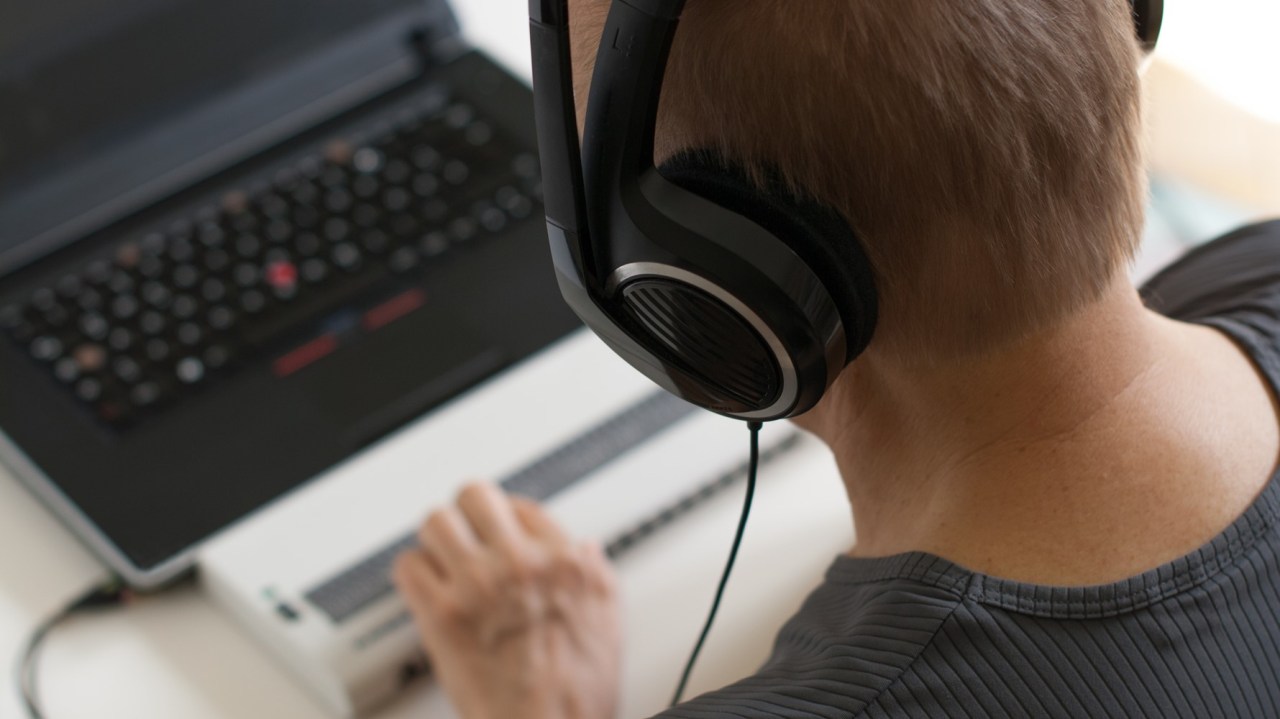
With more people online during the pandemic and an increased prevalence of accessibility laws and regulations, digital accessibility has become a hot topic on which every company with a website and/or app needs to focus their efforts. It’s not only because all people should be able to access your content without barriers, but penalties and lawsuits potentially await companies who put too little effort into optimizing their websites and tools for accessibility. The Web Content Accessibility Guidelines (WCAG) issued by the World Wide Web Consortium contain the standards that companies should follow to make their digital applications and documents accessible for everyone. It’s not just the teams working on websites that need to be aware of these standards, so too should others in the organization. Accessibility is everyone’s responsibility.
Digital accessibility is a very broad concept. It doesn’t only refer to people with visual disabilities such as color-blindness. It also concerns the hearing-impaired, people with learning or attention disabilities, neuromuscular disorder, situational disabilities like a broken arm, and many more. If a user is unable to use a mouse, they need to use assistive technology that includes screen readers, magnifiers, speech-to-text software, or voice recognition software. Around 20% of the world population lives with a disability.
So how do you make sure your website is accessible?
The list of things that companies can work on to improve digital accessibility is almost endless, so here are a few main points to get you started:
- Set up an Accessibility Committee with people from different disciplines and schedule regular meetings to discuss accessibility and what/how to optimize your digital assets.
- There are tools that can help you improve digital accessibility. At CWT we use Siteimprove. This tool scans our sites and lists accessibility issues in detail. You can gain points for solved issues, and this way work your way to a more accessible website.
- Have IT work on solving the technical issues, and content managers on solving the content issues. Be sure that everyone is aware of the ‘do’s’ and ‘don’ts’ of digital accessibility.
- Accessibility concerns everyone in the organization so encourage teams to learn about digital accessibility.
- Create an accessibility statement and place it on your website. Update it on a regular basis.
And on a more detailed level, here are some examples of accessibility optimization on websites:
- Alt texts for links and images
- Content written in plain language
- Contrast in color combinations
- Large and/or enlargeable images
- Underlined/colored links
- Large click areas
- No flashing effects
At CWT we aim to be an inclusive company and therefore accessibility is high on our priority list. Not only digitally throughout our websites, mobile app and tools, but also in our offices.
Image credits: Adobe Stock
-

ISO: 14001: How to build a robust environmental management system for a changing workforce
Just as organizations have systems to manage human resources and finance, it is equally critical that they have an Environmental Management System (EMS) for managing environmental issues.
Like all organizations, we have a duty to implement practices that protect our planet. For an organization of our size and scope – comprised of 12,000 employees with a physical presence in 140 countries – it’s a moral imperative as it is a business one.
In January 2022 CWT’s UK EMS was awarded an ISO:14001 certification for “The organization and booking of corporate travel including hotel, car hire, rail and air travel booking.”
As an experienced Environment, Health & Safety (EHS) practitioner I’ve learned that the secret to success in system terms is to constantly course correct as things change, and then adapt accordingly. The EMS is not something you dust down once a year, pre-audit. This does not go unnoticed by experienced external auditors. They are grateful to see that we keep our system alive year-round, and this is reflected in our retention of this certification. But creating and adapting an EMS in these uncertain times is no mean feat. Here are three tips to help boost your organizations’ commitment to the environment.
Change is inexorable
If properly implemented an EMS can help reduce operating costs and enable better management of environmental risks both now and in the future. It demonstrates your commitment and may even open up new business opportunities. It’s critical to stay agile.
Translating a passion for the environment into effective action has been made even harder by the pandemic. As a service sector we encountered a mass move to home working which impacted normal operations. Ultimately this has distorted our consumption over this period. Energy and the cost burden has fallen to remote workers. We have had to think laterally around things like waste disposal because some functions have been particularly busy throughout the pandemic and generated special waste which we have needed to dispose of through approved contractors. It’s most definitely a project and all internal stakeholders must be fully engaged, mobilized and open to change.
Have a measurable plan of action
Our Environmental Management System (EMS) is built around the elements of the ISO14001:2015 standard. This requires us to understand and be able to describe the context in which our company operates. We have also identified our environmental aspects (cause) and impacts (effect), as well as risks and opportunities. The standard requires us to set measurable objectives, which our operating procedures help us manage. Our stakeholder analysis helps us understand who we are engaging with through our communications. It’s important to ensure adequate, well-trained resources. Our management review process is fed by an internal system audit that drives continual improvement. The external verification audit is the grand finale to each year’s endeavours.
Engage employees
Training and empowering local representatives is critical to success. We have appointed Responsible Business Champions (RBCs) to act as contacts for employees at a local level to facilitate activities linked to global campaigns like ‘Environmental Awareness Week.’ For all new employees – both home and office based – we provide welcome presentations giving links to all our policies. At our locations we guide employees to a dedicated internal resource where they can access training and, more importantly, they are encouraged to complete our Environmental Viewpoint survey which tells us what they really think, so that we can plan further improvements to our system.